Foods High in Fiber: What 30 Grams a Day Looks Like on a Real Plate
The Short Answer
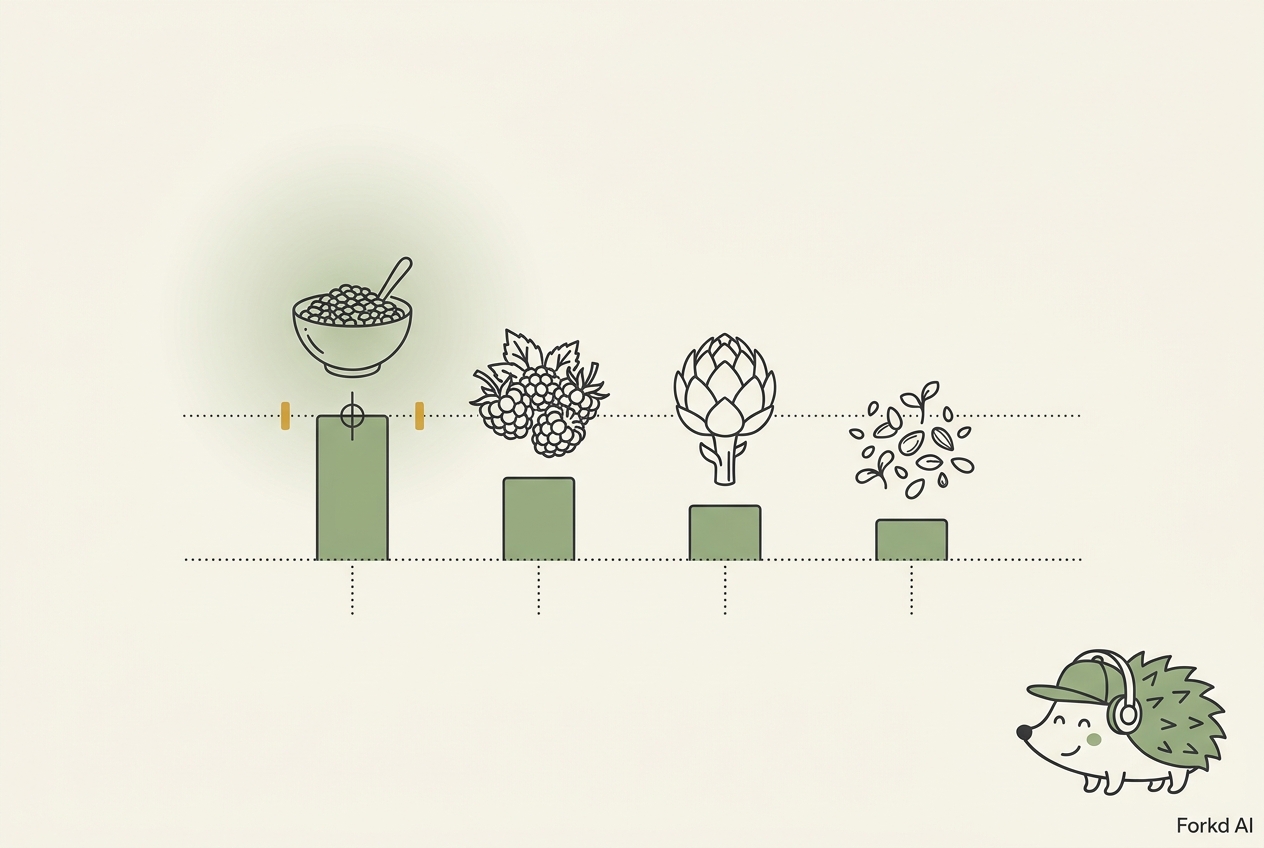
The foods highest in fiber are split peas (16 g per cooked cup), lentils (16 g), black beans (15 g), chickpeas (12 g), chia seeds (10 g per ounce), and raspberries (8 g per cup). Most adults need 25 to 38 grams a day and fall short. Eating legumes once a day closes most of that gap.
Why Do So Few People Eat Enough Fiber?
Fiber might be the least controversial nutrient there is. Nobody argues about whether you need it, and still almost nobody gets enough. According to the Dietary Guidelines for Americans, about 90 percent of women and 97 percent of men fall short of the recommended intake.
Part of the reason is what's on the shelves. White bread, most breakfast cereals, and fruit juice have had the bran milled off or the pulp pressed out long before they reach your kitchen. The other part is that fiber is hard to see. You can look at a chicken breast and make a decent guess about its protein, but nobody eyeballs a bowl of soup and wonders how much fiber is in it. The foods that carry the most of it, like dried beans, split peas, and artichokes, also aren't what most people cook on a Tuesday night.
We've already written about how much fiber you should eat daily and why it matters for weight loss. This guide is the shopping-list side of the same question, with USDA numbers for portions people actually eat.
How Much Fiber Do You Need Per Day?
The Institute of Medicine sets the Adequate Intake at 14 grams for every 1,000 calories you eat. For most adults that works out to:
| Group | Adequate Intake |
|---|---|
| Men 19 to 50 | 38 g/day |
| Women 19 to 50 | 25 g/day |
| Men 51+ | 30 g/day |
| Women 51+ | 21 g/day |
Those targets hold up well against the outcome data. A 2019 series of meta-analyses in The Lancet, drawing on 185 prospective studies and 58 clinical trials, found the biggest reductions in heart disease, stroke, type 2 diabetes, and colorectal cancer among people eating 25 to 29 grams a day. The dose-response curves suggested even higher intakes could add further protection.
For most people, 30 grams is a sensible everyday goal. It's high enough to matter, and you can reach it without turning every meal into a bean dish.
What Does Fiber Do Once You Eat It?
Humans don't make the enzymes needed to break fiber down, so it passes through the small intestine largely intact. In the large intestine, gut bacteria ferment a good share of it into short-chain fatty acids, which the cells lining your colon use for fuel.
Soluble fiber, found in oats, beans, and apples, forms a gel that slows digestion and softens the rise in blood sugar after a meal. Insoluble fiber from wheat bran, nuts, and vegetable skins mostly adds bulk and keeps things moving. You don't need to track the two separately, since whole plant foods almost always contain both.
If you'd rather watch than read, Mayo Clinic's one-minute explainer covers the basics:
Which Foods Are Highest in Fiber?
Every number below comes from USDA FoodData Central, calculated for the portion shown.
Which beans and legumes have the most fiber?
| Food | Portion | Fiber | Calories |
|---|---|---|---|
| Split peas, boiled | 1 cup (196 g) | 16.3 g | 231 |
| Lentils, boiled | 1 cup (198 g) | 15.6 g | 230 |
| Black beans, boiled | 1 cup (172 g) | 15.0 g | 227 |
| Kidney beans, boiled | 1 cup (177 g) | 13.1 g | 225 |
| Chickpeas, boiled | 1 cup (164 g) | 12.5 g | 269 |
| Green peas, boiled | 1 cup (160 g) | 8.8 g | 134 |
Legumes do most of the heavy lifting. A single cup of lentils covers more than 60 percent of a woman's daily target, and it brings a solid dose of protein along with it. If cooking dried beans feels like a project, canned beans are fine. Draining and rinsing them washes away a good part of the added sodium.
Which fruits have the most fiber?
| Food | Portion | Fiber | Calories |
|---|---|---|---|
| Raspberries | 1 cup (123 g) | 8.0 g | 64 |
| Avocado | 1/2 fruit (100 g) | 6.7 g | 160 |
| Pear | 1 medium (178 g) | 5.5 g | 101 |
| Apple, with skin | 1 medium (182 g) | 4.4 g | 95 |
| Prunes | 5 prunes (48 g) | 3.4 g | 114 |
Raspberries surprise most people. A cup has about as much fiber as half a cup of black beans for a little over half the calories.
Leave the skin on your apple. USDA lists a peeled raw apple at 1.3 grams of fiber per 100 grams against 2.4 grams with the skin, so peeling throws away almost half. Avocado is high in fiber and also high in calories; our page on calories in an avocado has the portion breakdown.
Which vegetables have the most fiber?
| Food | Portion | Fiber | Calories |
|---|---|---|---|
| Acorn squash, baked | 1 cup cubes (205 g) | 9.0 g | 115 |
| Artichoke, boiled | 1 medium (120 g) | 6.8 g | 64 |
| Sweet potato, baked (flesh) | 1 cup (200 g) | 6.6 g | 180 |
| Broccoli, boiled | 1 cup chopped (156 g) | 5.1 g | 55 |
| Brussels sprouts, boiled | 1 cup (156 g) | 4.1 g | 56 |
Vegetables rarely match beans gram for gram. They make up for it by being so low in calories that you can eat a lot of them. Two cups of broccoli is a normal dinner side, and it adds 10 grams.
Which seeds, nuts, and grains have the most fiber?
| Food | Portion | Fiber | Calories |
|---|---|---|---|
| Chia seeds | 1 oz (28 g) | 9.8 g | 138 |
| Whole-wheat spaghetti, cooked | 1 cup (117 g) | 4.6 g | 174 |
| Oats, dry | 1/2 cup (41 g) | 4.1 g | 153 |
| Almonds | 1 oz (28 g) | 3.5 g | 164 |
| Popcorn, air-popped | 3 cups (24 g) | 3.5 g | 93 |
| Flaxseed, ground | 1 tbsp (7 g) | 1.9 g | 37 |
Popcorn deserves more credit than it gets. Three cups of air-popped popcorn match an ounce of almonds for fiber at a little over half the calories, although butter and oil change that math fast.
Which High-Fiber Foods Give You the Most Fiber Per Calorie?
Per-serving tables can mislead you if you're eating in a calorie deficit. Chia seeds look spectacular until you notice that an ounce costs 138 calories. Measuring fiber per 100 calories reshuffles the list:
| Food | Fiber per 100 calories |
|---|---|
| Raspberries | 12.5 g |
| Artichoke | 10.8 g |
| Broccoli | 9.4 g |
| Acorn squash | 7.9 g |
| Brussels sprouts | 7.2 g |
| Chia seeds | 7.1 g |
| Lentils | 6.8 g |
| Black beans | 6.6 g |
| Popcorn, air-popped | 3.7 g |
| Almonds | 2.2 g |
Legumes land in the middle here, but they're the only foods on the list that also carry serious protein. Since fiber and protein both help you feel full, beans are still the best all-rounder if you're trying to lose weight without being hungry all afternoon.
Nuts sit at the bottom per calorie. They're worth eating for plenty of other reasons, just not as your main fiber source.
What Does a 30-Gram Fiber Day Look Like?
This is an ordinary day of eating with no supplements, fiber bars, or bran cereal:
| Meal | What's on the plate | Fiber |
|---|---|---|
| Breakfast | 1/2 cup oats (dry weight), cooked, with 1 cup raspberries | 12.1 g |
| Lunch | Burrito bowl with 1/2 cup black beans, plus a medium apple | 11.9 g |
| Dinner | 1 cup whole-wheat spaghetti with 1 cup broccoli | 9.7 g |
| Snack | 1 oz almonds | 3.5 g |
| Total | 37.2 g |
That lands within a gram of the 38-gram target for men under 50 and comfortably over it for everyone else. It also leaves out the rice, tortilla, salsa, and pasta sauce that would realistically be on those plates, all of which add a little more.
Lunch is usually where the biggest gain hides. A sandwich on white bread with deli meat has very little fiber, and adding half a cup of beans to whatever you already eat for lunch adds 7.5 grams.
How Quickly Should You Increase Your Fiber Intake?
Gradually. People who jump from 15 grams to 40 overnight tend to end up bloated and convinced that fiber doesn't agree with them. The bacteria in your gut need a couple of weeks to adjust to the new supply.
Add one high-fiber food at a time and give it a few days before adding the next. Drink more water as you go, because fiber holds water in the gut, and a high-fiber diet with too little fluid is a classic recipe for constipation. If one food keeps giving you trouble (beans and Brussels sprouts are the usual suspects), a smaller portion often works better than dropping it entirely.
How Do You Track Fiber Without Reading Every Label?
Packaged foods list fiber on the Nutrition Facts panel. The trouble is that the best sources, like beans cooked from dry, fresh fruit, and vegetables, don't come with a label. A week of logging will tell you whether you're sitting nearer 15 grams or 30, and for most people the honest answer is lower than they expected.
Forkd's micronutrient tracker reads fiber along with calories, macros, and 15+ vitamins and minerals from a photo, a voice note, or a line of text, using per-ingredient USDA values. If you're also watching carbs, the macro tracker shows total carbs, fiber, and net carbs side by side, which pairs well with our explainer on net carbs vs total carbs. Search the App Store for "AI Calorie Tracker: Forkd".
Frequently Asked Questions
What food has the most fiber per serving?
Among everyday foods, cooked split peas and lentils lead at roughly 16 grams per cup, with black beans close behind at 15 grams. Chia seeds are the most concentrated by weight at 34 grams per 100 grams, though a typical 1-ounce serving gives you about 10 grams.
Is it possible to eat too much fiber?
No upper limit has been set for fiber from food. Very high intakes, especially when increased quickly, can cause bloating, gas, and constipation if you don't drink enough fluid. Extremely large amounts may also reduce absorption of some minerals, which is one more reason to get fiber from food rather than stacking supplements.
Are fiber supplements as good as high-fiber foods?
Supplements such as psyllium can help with specific problems like constipation, but they aren't a substitute for high-fiber food. The Lancet meta-analyses that linked higher fiber intake to lower disease risk excluded supplement trials, so their findings describe fiber that arrives with the vitamins, minerals, and other compounds in whole plant foods.
Does fruit juice count toward your fiber intake?
Barely. USDA lists fresh orange juice at 0.2 grams of fiber per 100 grams, while a raw orange has 2.4 grams per 100 grams. Juicing leaves most of the fiber behind in the pulp and membranes, so a full cup of juice gives you about half a gram.
How can I get more fiber on a low-carb diet?
Lean on foods that are high in fiber and low in net carbs: avocado, chia and flax seeds, broccoli, Brussels sprouts, raspberries, and almonds. Fiber is subtracted when you calculate net carbs, so these foods raise your fiber intake without eating into a tight carb budget.
Key Takeaways
- Adults need roughly 25 to 38 grams of fiber a day (14 grams per 1,000 calories), and about 90 to 97 percent of Americans fall short.
- Legumes lead per serving: split peas (16.3 g per cup), lentils (15.6 g), and black beans (15.0 g).
- Per calorie, raspberries (12.5 g per 100 calories), artichokes, and broccoli come out on top.
- A normal day of oats, raspberries, black beans, an apple, whole-wheat pasta, broccoli, and almonds reaches 37 grams.
- Increase fiber gradually and drink more water to avoid bloating and constipation.
References
- Reynolds A, Mann J, Cummings J, Winter N, Mete E, Te Morenga L. (2019). Carbohydrate quality and human health: a series of systematic reviews and meta-analyses. The Lancet, 393(10170), 434-445. pubmed.ncbi.nlm.nih.gov
- Institute of Medicine (2005). Dietary Reference Intakes for Energy, Carbohydrate, Fiber, Fat, Fatty Acids, Cholesterol, Protein, and Amino Acids. National Academies Press. nap.nationalacademies.org
- U.S. Department of Agriculture and U.S. Department of Health and Human Services. Dietary Guidelines for Americans, 2020-2025. dietaryguidelines.gov
- Mayo Clinic. Dietary fiber: Essential for a healthy diet. mayoclinic.org
- USDA FoodData Central. Fiber and calorie values for split peas (172429), lentils (172421), black beans (173735), kidney beans (175194), chickpeas (173757), green peas (170420), raspberries (167755), avocado (171705), pears (169118), apples with skin (171688), apples without skin (171689), prunes (168162), acorn squash (169293), artichokes (168386), sweet potato (168483), broccoli (169967), Brussels sprouts (169971), chia seeds (170554), whole-wheat pasta (168910), oats (173904), almonds (170567), air-popped popcorn (167959), flaxseed (169414), oranges (169097), and orange juice (169098). fdc.nal.usda.gov
Written by
Vineet Karhail builds Forkd, the AI-powered calorie and nutrition tracking app, and writes its research-backed guides on calories, macros, and micronutrients.