Does Burning or Charring Food Destroy Its Nutrients?
The Short Answer
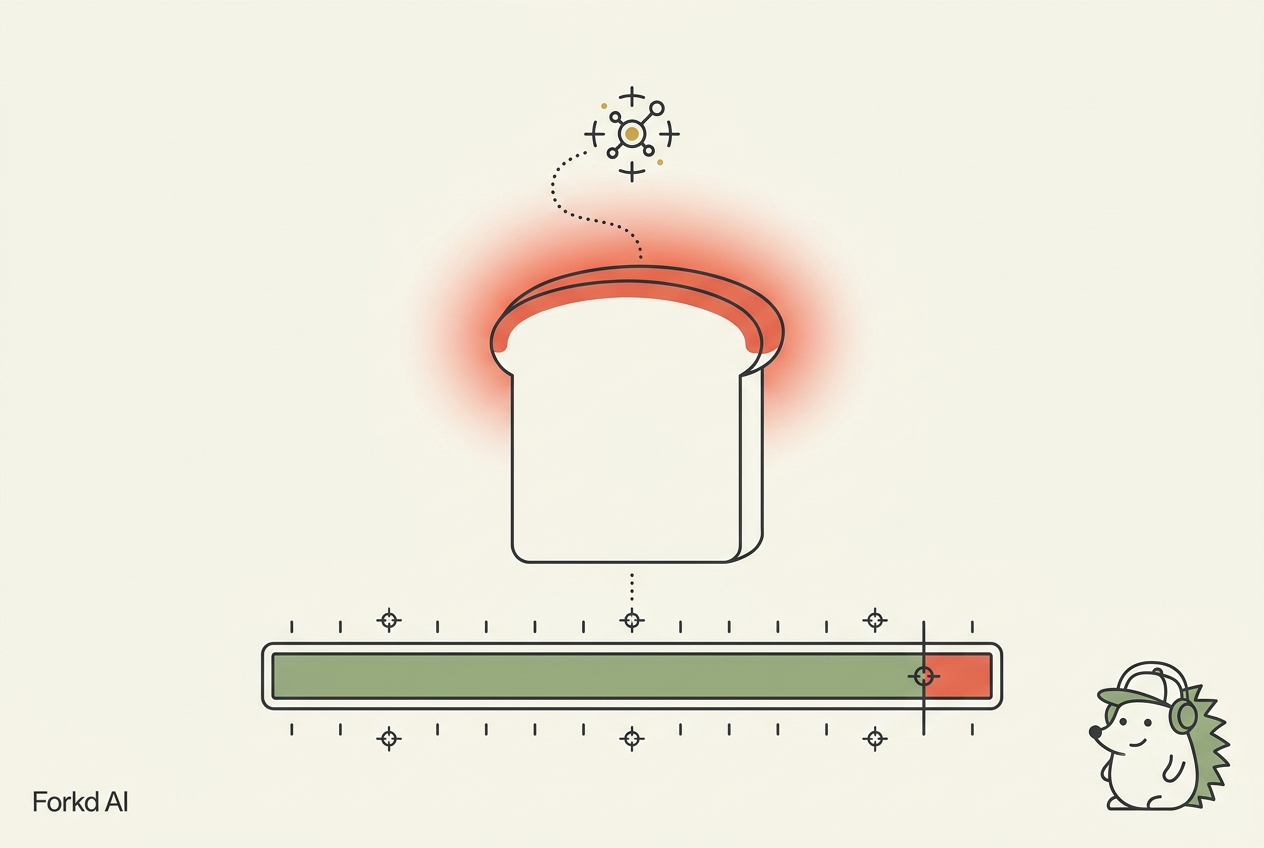
Charring destroys almost no calories, since the blackened bit is a tiny fraction of the food's mass. The real issues are chemical: heavy char forms HCAs and PAHs in meat and acrylamide in starchy food, plus local loss of heat-sensitive vitamins like C, B1, and folate. Protein and fat take the biggest hit; occasional char isn't a real risk.
Disclaimer
This article is for information only and does not replace medical advice. Needs vary with age, sex, and situation (pregnancy, conditions, medication): if in doubt or symptomatic, talk to a health professional.
What Actually Happens When Food Chars?
Somewhere around 285°F (140°C), sugars and amino acids on the surface of your food start rearranging themselves into hundreds of new flavor compounds. That's the Maillard reaction, and it's the whole reason seared steak and toasted bread taste better than their boiled versions. Push past roughly 350-400°F, and you leave Maillard territory for something rougher: pyrolysis. Sugars, starches, and proteins start breaking down and recombining into carbon. That black crust on an overcooked marshmallow or a forgotten piece of toast is, chemically, most of the way to charcoal.
So charring isn't "extra cooking." It's a different reaction, on a different part of the food, producing a different result. Everyone's eaten some version of it. Not everyone's asked what it's actually doing to the food.
Does Charring Destroy the Calories in Food?
Barely, and this is where a lot of people's intuition runs backwards. A blackened crust looks dramatic, so it's easy to assume you've burned off a meaningful chunk of the food's energy. You haven't. The char is a thin surface layer, usually a few percent of the total mass. Losing it doesn't meaningfully dent the calorie count of the steak, the toast, or the potato underneath.
What's actually true is narrower and less satisfying: the carbonized bit itself contributes close to zero usable calories, because it's largely elemental carbon at that point, not intact carbohydrate, fat, or protein. Your body can't extract energy from carbon the way it can from starch. But since that carbonized bit is such a small fraction of what you're eating, the practical effect on total calories is negligible. You're not "burning off" your bagel by toasting it dark.
Can the Body Digest a Heavily Charred Bit?
Not really, and that's actually the more honest way to think about it than "hard to digest." A genuinely blackened piece of food behaves less like tough fiber and more like inert material. Digestive enzymes are built to break specific chemical bonds in starch, protein, and fat. Carbonized carbon doesn't have those bonds anymore, so there's nothing for the enzymes to grab onto. Mostly, it just passes through.
This matters because it reframes the whole question. People ask whether burnt food is "harder on the stomach," picturing something like extra-tough steak. It's closer to eating a small amount of ash mixed in with your meal: not digested, not really doing anything nutritionally, in either direction. The exception is if you're eating enough char to physically irritate the gut, which would take a genuinely unusual amount of it.
Which Nutrients Take the Biggest Hit: Carbs, Fat, Protein, or Vitamins?
They don't lose ground evenly, and the split is worth knowing if you're the kind of person who actually wants the flavor of the char and not just the food underneath.
Protein takes the most measurable hit, and it starts well before anything actually chars. The Maillard reaction targets lysine specifically, one of the amino acids your body can't make on its own. Research on high-heat processing has found lysine's bioavailability can drop by up to 42%, and the resulting crosslinked proteins resist digestive enzymes by another 19-27% on top of that. Push into full carbonization and whatever protein was in that layer is no longer functionally protein. It's just carbon with nitrogen stuck in it.
Fat's damage is more about what forms than what's lost. Direct flame contact with dripping fat produces polycyclic aromatic hydrocarbons (PAHs), and the fat itself oxidizes into compounds you'd rather not be eating regularly. You're not losing a meaningful number of fat calories from charring; you're adding compounds that weren't there before.
Carbs and starches mostly just become inert, the same story as the general "does the body digest it" question above, with the added complication of acrylamide (more on that below).
Vitamins are the most fragile of the four, but also the most localized in their loss. Vitamin C, thiamin (B1), and folate are all heat-sensitive and break down under sustained high heat, well before charring even enters the picture. A char layer is simply the extreme end of a process that's already been chipping away at these vitamins throughout cooking. Fat-soluble vitamins (A, D, E, K) hold up considerably better.
If you had to rank it: protein loses the most usable nutrition, vitamins are the most fragile, and carbs and fat mostly just sit there, inert or altered, rather than "lost" in any calorie sense.
What New Compounds Actually Form in Charred Food?
This is the part that actually matters for health, more than any nutrient-loss question.
Heterocyclic amines (HCAs) form when amino acids, sugars, and creatine in muscle meat react at high heat, particularly in the blackened parts. The National Cancer Institute has identified 17 different HCAs with potential cancer-related activity, and the longer and hotter the cooking, the more of them you get.
Polycyclic aromatic hydrocarbons (PAHs) form when fat drips onto flame or a hot surface, and the resulting smoke deposits them back onto the food. This is a grilling-specific problem more than an oven or pan one, since it requires that direct flame contact.
Acrylamide shows up in starchy foods, not meat: toast, roasted potatoes, coffee, French fries. It forms from a reaction between asparagine (an amino acid common in plants) and sugars, and IARC classifies it as Group 2A, "probably carcinogenic to humans," largely on the strength of animal studies at doses far higher than anyone's actually eating.
None of these compounds show up in meaningful amounts until you're well past normal browning and into genuinely blackened territory. A golden-brown sear isn't the same exposure as a charred crust, even though both technically involve the Maillard reaction.
How Much Charring Actually Matters?
This is where it's worth being honest instead of alarmist. Population studies do link heavy, regular consumption of charred and well-done meat to higher rates of colorectal, pancreatic, and a few other cancers. That's a real signal, not a fringe claim. But it's built on people eating charred meat often and in quantity, not on the burnt edge of your weeknight chicken thigh once in a while.
The trimmed-off black bit of toast isn't the thing to lose sleep over. A habit of charcoal-grilled, well-done meat multiple times a week, for years, is a different exposure entirely.
How Do You Keep the Char Flavor and Cut the Risk?
A few things actually move the needle, backed by the same research that flagged the risk in the first place:
- Marinate first. Acidic marinades (vinegar, citrus, wine) for at least 30 minutes measurably reduce HCA formation on the surface.
- Pre-cook before you grill. Microwaving meat for about two minutes before it hits the grill cuts HCA formation by roughly 90%, since it shortens the time the surface spends at grilling temperature.
- Keep meat off direct flame. Moving the grate up, using indirect heat, or flipping more frequently all reduce the fat-drip-to-flame contact that produces PAHs.
- Trim the genuinely black bits. Not the golden-brown sear, just the parts that have actually gone black. That's where the concentration of HCAs, PAHs, and acrylamide actually sits.
Forkd's hidden calorie detection doesn't flag HCAs or PAHs specifically since those aren't calories or macros, but if you're logging a meal that includes a charred sear, the macro tracker will still catch the protein and fat accurately from a photo. Search the App Store for "Forkd: Nutrition Intelligence."
Frequently Asked Questions
Does burning food remove calories?
Almost none. The charred layer is a small fraction of the food's total mass, and while that specific layer contributes close to zero usable calories, it doesn't meaningfully lower the calorie count of the food as a whole.
Is slightly burnt toast dangerous?
Occasional lightly burnt toast isn't a meaningful risk. The concern is with genuinely blackened crusts eaten regularly, since acrylamide concentrates in the darkest parts of baked and roasted starches.
Why does burnt meat taste different from just well-cooked meat?
Past a certain temperature, the Maillard reaction gives way to pyrolysis, where sugars, starches, and proteins break down into carbon and bitter-tasting compounds. That's a distinct chemical process from browning, not just "more" of it.
Does charring destroy vitamin content?
Charring accelerates the destruction of heat-sensitive vitamins like C, B1, and folate, but this loss happens throughout cooking, not only in the black bits. Fat-soluble vitamins (A, D, E, K) are more heat-stable.
Is grilled food automatically worse than baked or pan-cooked food?
Grilling adds a specific risk, PAHs from fat dripping onto an open flame, that baking and most pan-cooking don't share. HCAs can form with any high-heat, direct-contact cooking method, and acrylamide is actually more associated with baking, roasting, and frying starchy foods than with grilling meat.
Key Takeaways
- Charring is chemically pyrolysis, not more Maillard browning, and it barely changes total calories since the char is a thin surface layer.
- A genuinely charred bit behaves more like inert carbon than tough food; the body doesn't meaningfully digest it either way.
- Protein loses the most usable nutrition (up to 42% less bioavailable lysine even before full charring); vitamins C, B1, and folate are the most heat-fragile; carbs and fat mostly become altered or inert rather than "lost."
- The real risk is new compounds: HCAs and PAHs in charred meat, acrylamide in charred starches, most of them concentrated in the visibly black parts.
- Marinating, microwaving meat before grilling, and trimming black bits meaningfully cut the risk without giving up the flavor entirely.
References
- National Cancer Institute. Chemicals in Meat Cooked at High Temperatures and Cancer Risk. cancer.gov
- American Cancer Society. Acrylamide and Cancer Risk. cancer.org
- U.S. Food and Drug Administration. Acrylamide. fda.gov
- International Agency for Research on Cancer. Acrylamide, Group 2A classification, as summarized in FDA and ACS guidance above.
- Nooshkam M, et al. Formation of advanced glycation end-products in foods during cooking, and their effect on lysine bioavailability and protein digestibility, as reviewed in Nutrition Research Reviews and related studies on Maillard reaction products. cambridge.org
- Missouri University Extension. Meat cooking methods may increase cancer risks (marinating and microwave pre-cooking HCA reduction). extension.missouri.edu
Written by
Vineet Karhail builds Forkd, the AI-powered calorie and nutrition tracking app, and writes its research-backed guides on calories, macros, and micronutrients.