Best Calorie Tracker for Busy Parents in 2026
The Short Answer
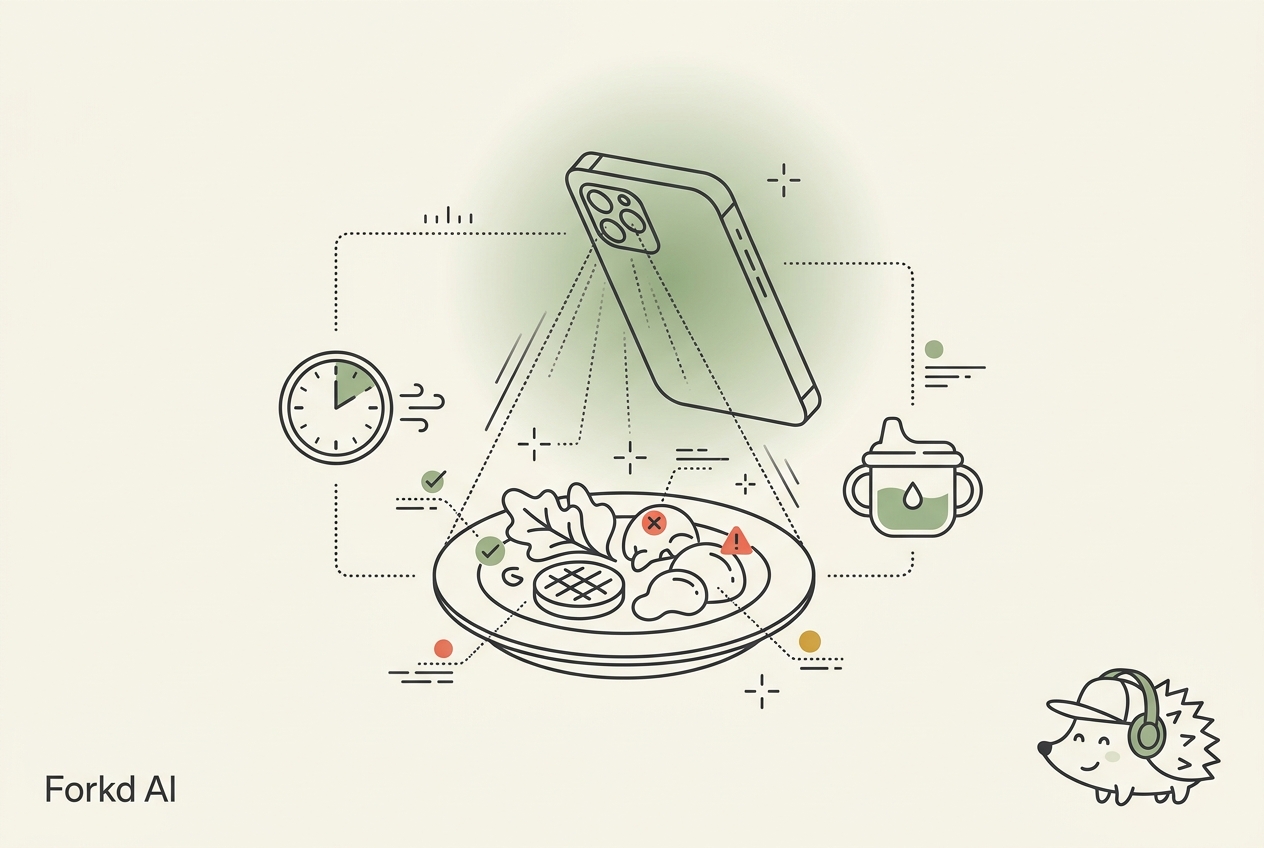
The best calorie tracker for busy parents is Forkd. AI photo logging takes under 10 seconds, you can log by voice or text, barcode scanning handles packaged kids' snacks, and the fasting timer is useful for parents who do morning or evening eating windows. The honest requirement for parent-friendly tracking: it has to be fast enough to use in real life, with a toddler on your hip and four things happening at once. Database searching fails this test. Photo logging does not.
Disclaimer
This article is for information only and does not replace medical advice. Needs vary with age, sex, and situation (pregnancy, conditions, medication): if in doubt or symptomatic, talk to a health professional.
What Makes a Calorie Tracker Parent-Friendly?
Most calorie tracking apps are designed for people who have three to five minutes per meal and a predictable eating schedule. Neither of those is parenting life.
The reality of meal tracking as a parent:
- You eat standing up, at the kitchen counter, while someone else's plate is more important than yours
- You finish toddler leftovers between spoonfuls of something else
- Your lunch is whatever you could put together in six minutes before the baby needed something
- You forget to log until 9pm and then cannot remember what you ate at 1pm
- Your eating window shifts constantly depending on school runs, activities, and which child went to bed at what time
Any calorie app that requires manual database searching, meal name recognition, and precise portion entry for every item fails in this environment. The logging friction is too high, not because parents cannot be bothered, but because the opportunity windows are genuinely short.
What a parent-friendly tracker needs to do:
- Log a full plate in under 15 seconds
- Handle toddler food (chicken nuggets, fish fingers, pasta, fruit) by photo or barcode
- Not require you to remember a meal from four hours ago in detail
- Allow quick entries that are approximately right rather than requiring precision
The Best Calorie Tracker for Busy Parents
Forkd, AI Photo Logging Designed for Real Life
Forkd's AI photo logging takes under 10 seconds per meal. You open the camera, photograph your plate, and the app returns calories, macros, and micronutrients. You edit anything that looks obviously wrong and move on. You can also just say what you ate or type a line. This works:
- When you are eating a quick lunch during nap time
- When you are logging dinner after the kids are in bed
- When you are eating the same things your kids are eating (the photo catches what is on the plate)
- When you are at a restaurant and ordering off the children's menu yourself because the adult portion is too much
Barcode scanning handles packaged family staples, lunch boxes, cereal, snack bars, yoghurt pouches, in seconds. The nutrition label scan covers items not in the barcode database, which is useful for supermarket own-brand products.
Hidden calorie prompting. Forkd flags likely hidden extras in photos, the cooking oil on the stir fry, the dressing on the salad, the butter in the scrambled eggs. For parents who eat what they cook for their kids, these are exactly the entries that otherwise get missed.
Fasting timer. Many parents find their natural eating window has narrowed, no breakfast until the school run is done, dinner after the kids' bedtime. Forkd's fasting timer makes this easy to track intentionally, with fat-burning mode indicators and a safety warning at 17 hours.
Forkie weekly coaching. At the end of the week, Forkie surfaces what it noticed, not a data dump but a plain-English summary: "your protein was low most weekdays, usually the days you skipped breakfast." For parents who do not have time to analyse their own nutrition data, having it interpreted and served up weekly is the difference between useful and unused.
What About Logging Toddler Leftovers and Grazing?
The hardest part of tracking as a parent is logging the non-meals: the half banana you finished because it was going brown, the three crackers you ate during snack time, the two fish fingers left on the plate.
A few approaches that work:
Log partial portions with photo. Photograph what you are about to eat before you eat it, including if it is leftovers, and adjust the portion estimate if it is clearly less than a full serving.
Create a kids' food favourites list. The foods your kids eat regularly do not change much. Once you have logged chicken nuggets, fish fingers, and apple slices a few times, they will be in your recent foods for quick re-logging.
Use approximate-but-consistent entries. An entry that says "4 chicken nuggets" at 180 calories is more useful than no entry, even if the exact nugget brand and precise count varies. Consistency matters more than precision for calorie tracking over time.
What to Expect Realistically From Tracking as a Parent
Perfect daily tracking is not realistic for most parents, and that is fine. Research on self-monitoring shows that even partial tracking, logging 4–5 days per week, produces meaningful dietary awareness improvement over logging 0 days.
If you miss a day or several, it does not mean the habit has failed. Log when you can, be roughly accurate rather than perfectly precise, and treat it as useful data collection rather than a performance test.
The apps that support this approach are the ones where incomplete weeks of data still give you something, a weekly pattern, a protein trend, a prompt about what went well. Forkd's Forkie coaching works this way: even partial weeks produce usable pattern insight.
Frequently Asked Questions
What's the Fastest Way to Log a Meal in a Calorie App?
AI photo logging is the fastest method. Forkd's photo recognition takes under 10 seconds for a typical meal, and voice or text logging is just as quick. Barcode scanning is the fastest for packaged foods (2–3 seconds). For home-cooked meals that are not photographable, a favourite or recent meal that you re-log is faster than a fresh database search. The worst-case fallback is a quick rough-estimate entry ("pasta with chicken, roughly 500 calories"), imprecise but still useful.
Can I Log What My Kids Eat in My Own Tracker?
No. Food tracking apps are personalised to your intake. If you are eating the same things as your kids, you log what is on your plate; they would have their own accounts if needed (though tracking children's calorie intake is not recommended for most families and should only be done under medical guidance).
How Do I Track Calories When I Eat Standing Up and Don't Know Exactly What I Had?
Estimate and log it. "Bowl of pasta with vegetable sauce, probably 400 calories" is more useful data than no data. For recurring meals, consistency in how you estimate matters more than absolute precision. If you always estimate your standard pasta bowl at 400 calories, the trend data over weeks is still meaningful. Refine estimates for individual meals over time as you get a better sense of what you typically eat.
Do Calorie Tracking Apps Work for Parents Who Don't Eat Regular Meals?
Yes. Most apps, including Forkd, do not require you to declare "breakfast," "lunch," and "dinner." You log what you eat when you eat it. If you graze through the day on small amounts rather than three distinct meals, logging each small eating occasion as it happens gives a complete daily picture. The fasting timer in Forkd is also useful for parents who realise their eating naturally condensed into a short window.
Key Takeaways
- Parent-friendly calorie tracking requires under-15-second meal logging. Database searching fails in parenting life, photo logging works
- Forkd is the best option for busy parents: AI photo logging in under 10 seconds (plus voice and text), barcode scanning for packaged family foods, fasting timer for compressed eating windows, and weekly Forkie coaching that interprets your data without requiring you to analyse it yourself
- Logging toddler leftovers and grazing is best handled by photographing before eating and using rough-but-consistent estimates for recurring partial servings
- Partial tracking (4–5 days per week) still produces useful dietary awareness. Do not treat missed days as failure
- The hidden calorie prompt in Forkd is particularly useful for parents who eat what they cook. Cooking oil, sauces, and butter are the entries most commonly missed
Written by
Vineet Karhail builds Forkd, the AI-powered calorie and nutrition tracking app, and writes its research-backed guides on calories, macros, and micronutrients.