Best Calorie Tracker for Shift Workers in 2026
The Short Answer
The best calorie trackers for shift workers are Forkd (fastest logging with an integrated fasting timer, critical for shift workers whose eating windows rotate with their schedule) and Cronometer (tracks vitamin D and B vitamins, which shift workers are at particular risk of deficiency). Shift work disrupts circadian rhythms, which affects hunger signals, sleep, and metabolic health, making tracking useful but also requiring a different approach than standard 9-to-5 calorie tracking.
Disclaimer
This article is for information only and does not replace medical advice. Needs vary with age, sex, and situation (pregnancy, conditions, medication): if in doubt or symptomatic, talk to a health professional.
Why Shift Work Makes Nutrition Harder
Shift work, including night shifts, rotating shifts, early starts, and irregular patterns, creates nutritional challenges that do not apply to people with regular schedules.
Circadian disruption. Eating at night, when circadian biology expects you to fast, disrupts hormonal signalling around appetite and metabolism. Research published in the International Journal of Obesity has shown that shift workers are at higher risk of obesity, metabolic syndrome, and type 2 diabetes than day workers, partly due to the mismatch between eating patterns and circadian timing.
Irregular hunger signals. Night work disrupts the hormones that regulate hunger (ghrelin) and satiety (leptin). Shift workers commonly report that they are hungry at irregular times, not hungry when they "should" be eating, or ravenously hungry during night shifts despite having eaten earlier.
Limited food options. Hospital canteens, factory vending machines, and petrol station convenience stores are not known for nutritious options. Shift workers often eat whatever is available during their window rather than whatever would optimally support their health.
Sleep disruption. Sleep deprivation increases appetite and shifts food preferences toward calorie-dense, high-sugar options. The caloric intake patterns of sleep-deprived shift workers tend to be higher and more erratic than those of rested day workers.
Vitamin D deficiency. Working night shifts means limited sun exposure, particularly for workers who sleep during daylight hours and work in indoor environments overnight. Vitamin D synthesis requires UV-B exposure to skin, and shift workers consistently show higher rates of deficiency than day workers.
How Shift Workers Should Approach Food Tracking
Standard calorie tracking assumes a stable daily schedule and a predictable meal pattern. Neither applies to rotating shift workers. Some adaptations:
Track by eating window, not by day. If you work a night shift from 10pm to 6am, your day of food intake may cross midnight. The calories you consume between 9pm and 7am form a meaningful eating unit even though it spans two calendar dates. Treat your eating window as the meaningful unit, not the calendar day.
Use the fasting timer for eating window awareness. Many shift workers find intermittent fasting useful not as a weight loss strategy but as a way to give circadian biology at least some structure: eating within a defined window even when that window shifts with your schedule. A fasting timer that can be started and stopped flexibly is more useful than one that resets at midnight.
Track consistently during one shift pattern, less during transitions. Rotating shift workers go through a transition period every time the schedule changes. During transition, sleep is particularly disrupted and eating patterns are most erratic. This is the hardest time to maintain tracking. Aim for consistent tracking during stable shift runs; tolerate gaps during transition.
Focus on protein adequacy and vitamin D. Two targets worth monitoring regardless of everything else: protein (supports muscle health, satiety, and helps counter sleep-deprivation-driven cravings) and vitamin D (low in most shift workers, affects immune function, mood, and metabolic health).
The Best Calorie Trackers for Shift Workers
Forkd, Best for Flexibility and Fasting Window Tracking
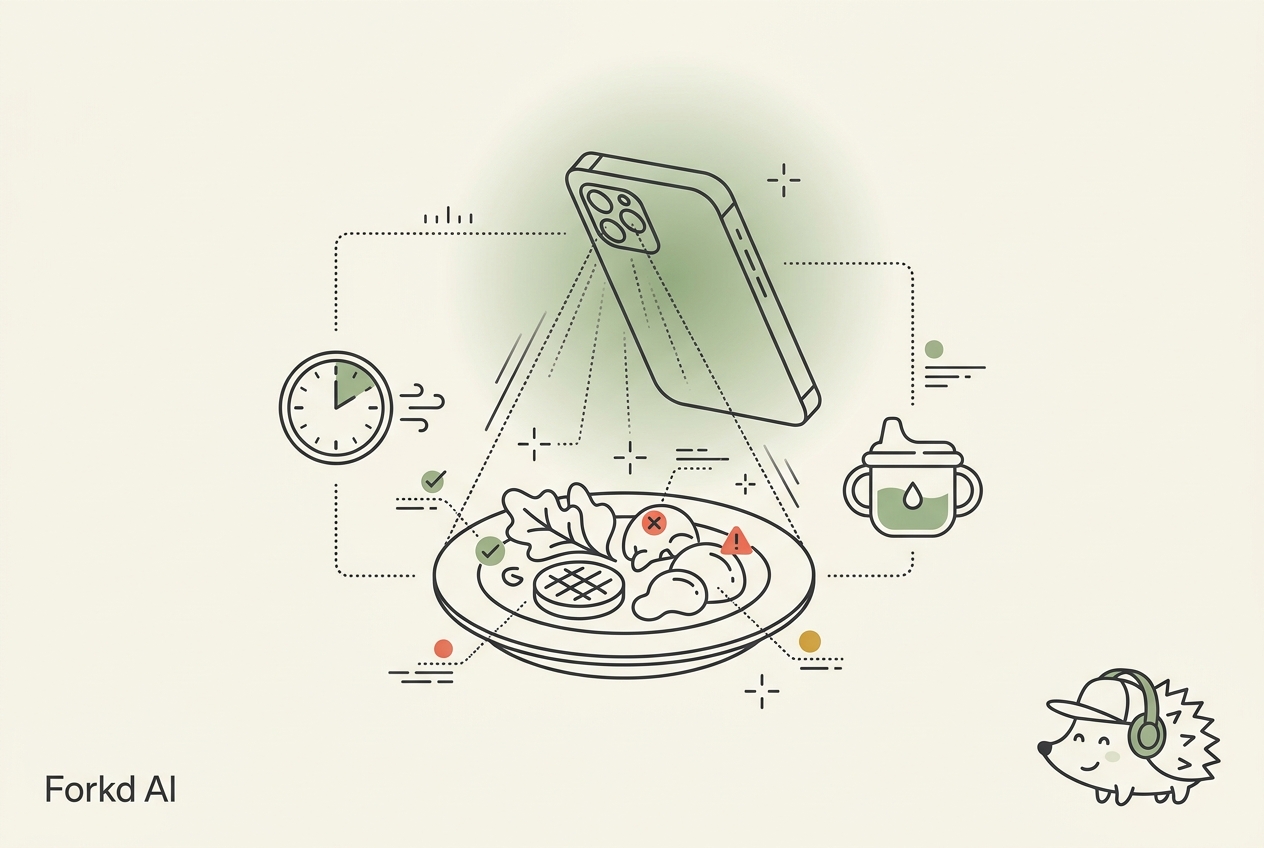
Forkd's flexible fasting timer, which can be started and stopped at any time rather than resetting at midnight, is well-suited to shift workers. If your eating window runs from 4pm to 10pm before a night shift, you can start the fast at 10pm and track 18 hours until you eat at 4pm the following day. The timer works across midnight, which matters for night shift workers.
AI photo logging takes under 10 seconds, and voice or text logging is just as quick. For someone on a 12-hour night shift logging a 2am meal in a hospital break room or factory canteen, spending under 10 seconds to photograph and log is realistic. Spending 3 minutes searching a database is not. That is the difference between tracking consistently and giving up.
Forkd's weekly Forkie coaching is useful for shift workers: the pattern analysis notices things like "your calorie intake is significantly higher on night shift weeks than day shift weeks," which is a known phenomenon but seeing it confirmed in your own data is more actionable than knowing it abstractly.
Vitamin D tracking in Forkd flags when dietary vitamin D is consistently low, relevant for shift workers who do not get sun exposure.
Cronometer, Best for Micronutrient Monitoring
Cronometer tracks vitamin D, B vitamins, iron, and magnesium, all relevant to shift work health. The research on shift work nutrition suggests that B12 and folate status may be affected by circadian disruption's impact on gut function; vitamin D is consistently deficient; magnesium affects sleep quality and stress response.
Logging is slower than Forkd but the nutritional data is more complete. For shift workers who have developed a health concern related to their schedule, metabolic syndrome, persistent fatigue, vitamin D deficiency, and are working with a GP, Cronometer's data export provides the complete nutritional picture.
Practical Strategies for Tracking on Rotating Shifts
Pre-log meals before your shift. Meal prepping for a night shift means you know what you will be eating before you get tired at 3am and the vending machine starts looking reasonable. Pre-logging those prepped meals confirms the nutritional content before you are in a low-willpower state.
Use photo logging for break room or canteen food. When your meal is whatever is available in a staff canteen or break room, photo logging handles unplanned meals better than database searching. Photograph your tray, get an approximate breakdown, move on.
Track water on night shifts. Dehydration is common during night shifts, both because people forget to drink when not in a normal daytime routine and because air conditioning in overnight environments can be dehydrating. Some apps, including Forkd, include water intake reminders.
Accept that night shift weeks will look different. Night shifts are associated with higher calorie intake, more processed food consumption, and worse dietary quality in most research. A tracking approach that allows you to see the pattern without being punitive about it is more useful than one that creates negative reinforcement around "bad" days.
Frequently Asked Questions
Does Eating at Night Cause Weight Gain in Shift Workers?
Timing of eating contributes to metabolic outcomes, but the mechanisms are complex. Research suggests that eating during circadian night (when your biology expects sleep) is associated with higher body weight and metabolic risk, independent of total calorie intake, though calorie intake is also higher in most studies of shift workers. Whether this is due to circadian disruption of metabolism, different food choices at night, or sleep deprivation's effect on appetite hormones is still being investigated.
Can Intermittent Fasting Help Shift Workers?
For shift workers who can maintain a consistent eating window, even if that window shifts with their schedule, some research suggests that consolidating eating into a limited window may support metabolic health better than grazing across an extended period of wakefulness. This is an evolving area. Discuss any extended fasting approach with a GP, particularly if you are working physically demanding shifts or have any health conditions.
How Do I Track Calories Across Midnight?
Most apps reset their food log at midnight. If your eating window spans midnight, for example, eating at 10pm and not finishing until 1am, you will have entries in two calendar days. Treat this as a practical nuisance rather than a tracking failure: log the entries as you eat them, and think of the weekly summary rather than the daily log as your primary data.
What Should Shift Workers Eat on Night Shifts to Manage Energy?
Research suggests moderate carbohydrate intake during night shifts (to avoid the energy crash that follows high-glycaemic meals at night), regular protein intake across the shift for sustained energy and satiety, and limiting highly processed or high-sugar foods that worsen the energy dysregulation that comes with night work. Staying hydrated and planning to eat something before the shift starts reduces the likelihood of relying on vending machine options at 3am.
Key Takeaways
- Shift work disrupts circadian rhythms, hunger hormones, and metabolic health. Standard calorie tracking advice designed for fixed schedules does not fully apply
- Forkd is best for shift workers: flexible fasting timer that works across midnight, photo logging in under 10 seconds for break room and canteen meals, and vitamin D tracking for the most common shift work deficiency
- Cronometer is best for complete micronutrient monitoring: vitamin D, B vitamins, magnesium, nutrients specifically relevant to shift work health
- Track by eating window rather than calendar day; pre-log prepped meals before night shifts; accept that night shift weeks will look nutritionally different from day shift weeks
- Vitamin D supplementation is worth discussing with a GP for shift workers who sleep during daylight hours. Dietary tracking makes the dietary gap visible, but supplementation typically fills it
Written by
Vineet Karhail builds Forkd, the AI-powered calorie and nutrition tracking app, and writes its research-backed guides on calories, macros, and micronutrients.