Foods High in Calcium (Including the Ones That Don't Come From a Cow)
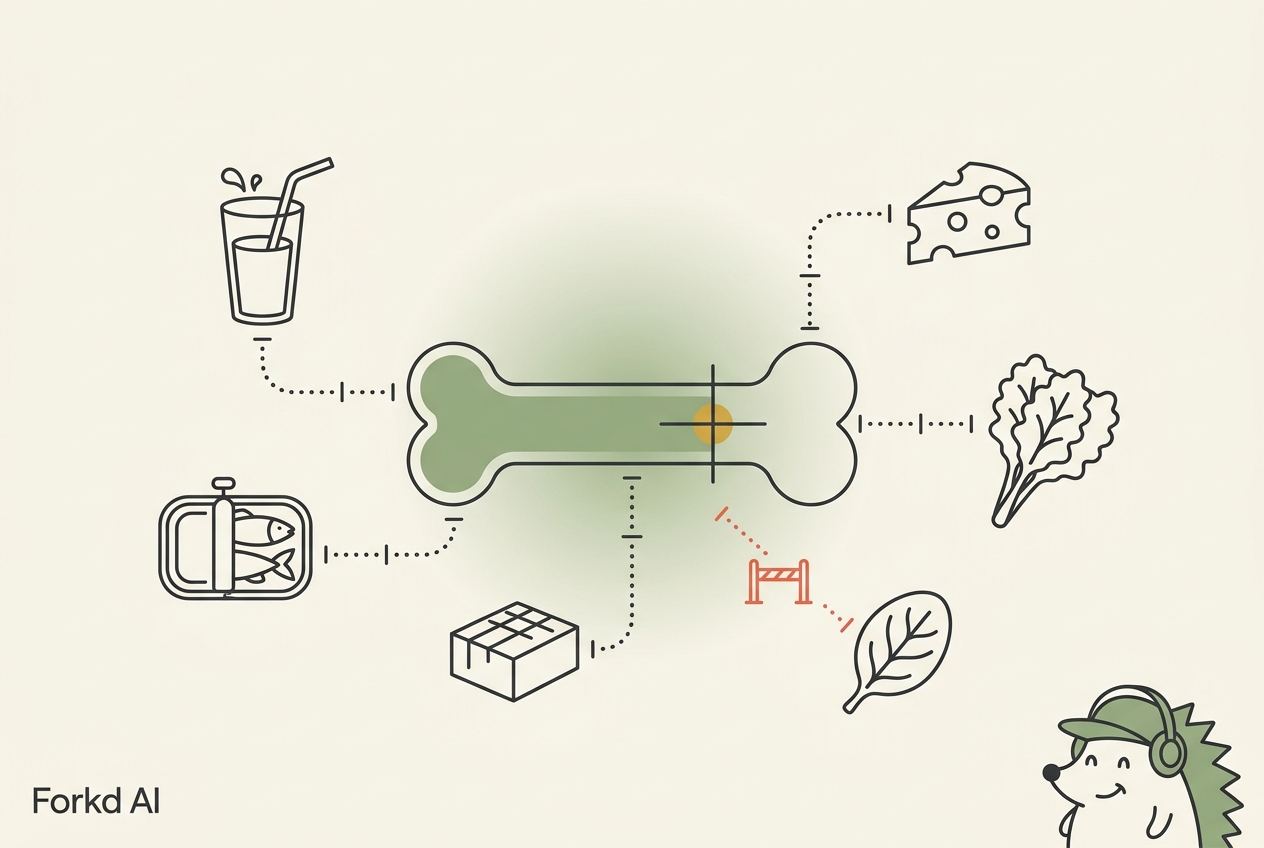
The Short Answer
Firm calcium-set tofu tops the list at 861 mg per half cup, followed by low-fat yogurt (448 mg per cup), a can of sardines with bones (351 mg), fortified orange juice (349 mg), and parmesan (335 mg per ounce). Most adults need 1,000 to 1,200 mg a day. Spinach looks rich in calcium, but you absorb little of it.
Why Is Calcium So Easy to Get Wrong?
Everyone knows calcium matters for bones. Fewer people know how much they need. Almost nobody knows how much they're actually getting.
Dairy does a lot of quiet work here. Cut back on milk and cheese, whether for a diet, lactose intolerance, or a move to plant-based eating, and calcium can drop fast. Nothing tells you. Your body keeps blood calcium steady by borrowing from your skeleton, so a shortfall can run for years before it shows up as low bone density.
The Dietary Guidelines for Americans flag calcium as a nutrient of public health concern, along with fiber, potassium, and vitamin D. We've already covered foods high in fiber and foods high in potassium. Calcium is the sneakiest of the group.
How Much Calcium Do You Need Per Day?
These are the National Academies' recommended intakes and upper limits:
| Group | RDA | Upper limit |
|---|---|---|
| Ages 9 to 18 | 1,300 mg | 3,000 mg |
| Adults 19 to 50 | 1,000 mg | 2,500 mg |
| Men 51 to 70 | 1,000 mg | 2,000 mg |
| Women 51+ | 1,200 mg | 2,000 mg |
| Men 71+ | 1,200 mg | 2,000 mg |
Women's needs jump at 51 because bone loss speeds up after menopause. Men get the same bump about twenty years later.
Mayo Clinic's one-minute version:
Which Foods Are Highest in Calcium?
All values come from USDA FoodData Central, calculated for the portion shown.
Which dairy foods have the most calcium?
| Food | Portion | Calcium | Calories |
|---|---|---|---|
| Yogurt, plain, low-fat | 1 cup (245 g) | 448 mg | 154 |
| Parmesan, hard | 1 oz (28 g) | 335 mg | 111 |
| Milk, 1% | 1 cup (244 g) | 305 mg | 102 |
| Cottage cheese, 2% | 1 cup (226 g) | 251 mg | 183 |
| Mozzarella, part-skim | 1 oz (28 g) | 222 mg | 72 |
| Cheddar, sharp | 1 oz (28 g) | 202 mg | 116 |
Plain yogurt beats milk comfortably, cup for cup. Parmesan is absurdly dense: one ounce gets you a third of the way to 1,000 mg. Cottage cheese is the letdown. It's a protein hero, but a full cup has less calcium than a glass of milk.
Which fish have the most calcium?
| Food | Portion | Calcium | Calories |
|---|---|---|---|
| Sardines, canned in oil, with bones | 1 can (92 g) | 351 mg | 191 |
| Pink salmon, canned, with bones | 3 oz (85 g) | 241 mg | 117 |
The bones are the whole point. USDA lists canned pink salmon at 283 mg of calcium per 100 grams with the bones and 60 mg without them. Canned fish bones are soft enough to mash right in. You won't notice them.
Which tofu, soy, and fortified foods have the most calcium?
| Food | Portion | Calcium | Calories |
|---|---|---|---|
| Tofu, firm, made with calcium sulfate | 1/2 cup (126 g) | 861 mg | 181 |
| Tofu, regular, made with calcium sulfate | 1/2 cup (124 g) | 434 mg | 94 |
| Orange juice, calcium-fortified | 1 cup (249 g) | 349 mg | 117 |
| Soy milk, calcium-fortified | 1 cup (243 g) | 299 mg | 104 |
| Edamame | 1 cup (155 g) | 98 mg | 188 |
Firm calcium-set tofu is the richest everyday food in this whole article. Dairy doesn't come close. The catch is the coagulant, so check the ingredients for calcium sulfate. Tofu made with other setting agents usually has less.
Fortified drinks are good sources, but the added calcium settles at the bottom. Shake the carton.
Which vegetables, beans, nuts, and seeds have the most calcium?
| Food | Portion | Calcium | Calories |
|---|---|---|---|
| Collard greens, boiled | 1 cup (190 g) | 268 mg | 63 |
| Spinach, boiled | 1 cup (180 g) | 245 mg | 41 |
| Turnip greens, boiled | 1 cup (144 g) | 197 mg | 29 |
| Chia seeds | 1 oz (28 g) | 179 mg | 138 |
| Kale, boiled | 1 cup (118 g) | 177 mg | 42 |
| White beans, boiled | 1 cup (179 g) | 161 mg | 249 |
| Bok choy, boiled | 1 cup (170 g) | 158 mg | 20 |
| Dried figs | 1/2 cup (75 g) | 121 mg | 186 |
| Almonds | 1 oz (28 g) | 76 mg | 164 |
Bok choy deserves a mention: 158 mg for 20 calories. Almonds get talked up as a calcium food, but an ounce gives you 76 mg. That's a nice bonus, not a strategy.
Why Is Spinach a Bad Source of Calcium?
On paper, a cup of cooked spinach has 245 mg of calcium. That's close to a glass of milk. In your gut, it's a different story.
Spinach is packed with oxalate, which binds calcium and carries it straight out of your body. In a 1988 study, 13 adults ate test meals of milk or spinach containing the same 200 mg of labeled calcium. They absorbed 27.6 percent of the calcium from milk and 5.1 percent from spinach. Absorption was higher from milk in every single person.
Kale flips the result. It's low in oxalate, and a 1990 study by the same researchers found women absorbed 40.9 percent of kale's calcium, compared with 32.1 percent from milk. Bok choy is another low-oxalate green.
Eat your spinach. It's great for other reasons. Just don't count it toward calcium.
What Does a 1,200 mg Calcium Day Look Like?
Here are two versions, one with dairy and one without.
With dairy
| Meal | What's on the plate | Calcium |
|---|---|---|
| Breakfast | 1 cup plain low-fat yogurt | 448 mg |
| Lunch | Salad with 1 oz shaved parmesan | 335 mg |
| Snack | 1 cup 1% milk | 305 mg |
| Dinner | 1 cup boiled kale on the side | 177 mg |
| Total | 1,265 mg |
Plant-based
| Meal | What's on the plate | Calcium |
|---|---|---|
| Breakfast | Oats made with 1 cup fortified soy milk | 299 mg |
| Lunch | 1 cup boiled collard greens | 268 mg |
| Dinner | Stir-fry with 1/2 cup firm calcium-set tofu | 861 mg |
| Total | 1,428 mg |
The plant-based day clears the bar more easily, and the tofu carries it. Take out the tofu and fortified soy milk, though, and you're scrambling. Our guide for vegan food trackers covers the other nutrients that need watching on a plant-based diet.
Should You Take a Calcium Supplement?
Food first, if you can manage it. The case for supplements is weaker than the bottle suggests.
A 2015 systematic review in the BMJ looked at calcium and fracture risk. Most of the 44 cohort studies it found showed no link between dietary calcium and fractures. In 26 randomized trials, supplements lowered total fracture risk by 11 percent. But the authors also found signs that the published data were tilted in favor of supplements.
If you do take one, three rules:
- Take 500 mg or less at a time. Absorption falls as the dose rises. You absorb about 36 percent of a 300 mg dose but only 28 percent of a 1,000 mg dose.
- Match the form to your meal. Calcium carbonate needs stomach acid, so take it with food. Calcium citrate works either way and suits older adults with low stomach acid.
- Count your food too. A supplement on top of a calcium-rich diet can push you past the upper limit.
Two more things. Calcium competes with iron for absorption, so keep supplements away from iron-rich meals, especially if your ferritin is low. Our guide to foods high in iron explains the interaction. And your gut needs vitamin D to absorb calcium well, which is why the two are usually discussed together. See the best vitamin D trackers for how much you need.
How Do You Know If You're Getting Enough Calcium?
A routine blood test won't tell you. Blood calcium stays in a tight range because your body pulls from bone to keep it there, so the number looks normal even when intake is low. Tracking what you eat is the practical way to find out.
Forkd's micronutrient tracker reads calcium alongside vitamin D, iron, potassium, and the rest of its 15+ nutrients from a photo, a voice note, or a line of text. It uses per-ingredient USDA values and shows how close you are to your target. Search the App Store for "AI Calorie Tracker: Forkd".
Frequently Asked Questions
Which non-dairy food has the most calcium?
Firm tofu made with calcium sulfate, at 861 mg per half cup. Next come a can of sardines with bones (351 mg), calcium-fortified orange juice (349 mg per cup), and fortified soy milk (299 mg per cup). Among vegetables, collard greens lead at 268 mg per cooked cup.
Is spinach a good source of calcium?
No. Cooked spinach has 245 mg of calcium per cup, but its oxalate binds most of it. In one study, people absorbed 5.1 percent of the calcium in spinach versus 27.6 percent from milk. Kale and bok choy are far better choices.
Can you get too much calcium?
It's rare from food alone. The upper limit is 2,500 mg a day for adults aged 19 to 50 and 2,000 mg after 50. People usually exceed it by stacking supplements on a calcium-rich diet, which can raise the risk of kidney stones and constipation.
Is cheese a good source of calcium?
Hard cheese is excellent. An ounce of parmesan has 335 mg, and an ounce of sharp cheddar has 202 mg. Cottage cheese is the exception, with 251 mg in a full cup.
Do you need vitamin D to absorb calcium?
Yes. Vitamin D helps your gut absorb calcium, so a calcium-rich diet does less for you when vitamin D is low. The main sources are sunlight, fatty fish, and fortified foods.
Key Takeaways
- Adults need 1,000 mg of calcium a day, rising to 1,200 mg for women over 50 and men over 70.
- Top sources per serving: firm calcium-set tofu (861 mg per half cup), low-fat yogurt (448 mg per cup), sardines with bones (351 mg per can), fortified orange juice (349 mg), and parmesan (335 mg per ounce).
- Spinach calcium is poorly absorbed (5.1 percent in one study), while kale's is absorbed well (40.9 percent).
- Most cohort studies find no link between dietary calcium and fracture risk. Supplement trials show a modest benefit, with signs of publication bias.
- If you supplement, take 500 mg or less at a time, and take calcium carbonate with food.
References
- National Institutes of Health, Office of Dietary Supplements. Calcium: Fact Sheet for Health Professionals. RDAs, upper limits, and supplement absorption. ods.od.nih.gov
- Institute of Medicine (2011). Dietary Reference Intakes for Calcium and Vitamin D. National Academies Press. ncbi.nlm.nih.gov
- Heaney RP, Weaver CM, Recker RR. (1988). Calcium absorbability from spinach. American Journal of Clinical Nutrition, 47(4), 707-709. doi.org
- Heaney RP, Weaver CM. (1990). Calcium absorption from kale. American Journal of Clinical Nutrition, 51(4), 656-657. doi.org
- Bolland MJ, Leung W, Tai V, et al. (2015). Calcium intake and risk of fracture: systematic review. BMJ, 351, h4580. doi.org
- U.S. Department of Agriculture and U.S. Department of Health and Human Services. Dietary Guidelines for Americans, 2020-2025. dietaryguidelines.gov
- USDA FoodData Central. Calcium and calorie values for low-fat yogurt (170886), parmesan (170848), 1% milk (170872), 2% cottage cheese (172182), part-skim mozzarella (170847), sharp cheddar (170899), sardines with bones (175139), canned pink salmon with bones (175175), canned pink salmon without bones (173724), firm tofu (172475), regular tofu (172476), calcium-fortified orange juice (169920), fortified soy milk (172456), edamame (168411), collard greens (170407), spinach (168463), turnip greens (170466), chia seeds (170554), kale (169238), white beans (175203), bok choy (170391), dried figs (174665), and almonds (170567). fdc.nal.usda.gov
Written by
Vineet Karhail builds Forkd, the AI-powered calorie and nutrition tracking app, and writes its research-backed guides on calories, macros, and micronutrients.