The Best Eating Window for Weight Loss, and Why Shorter Isn't Always Better
The Short Answer
Research supports an 8–10 hour eating window as effective for weight loss and metabolic health. However, a 2024 study linked 8-hour windows specifically to elevated cardiovascular risk in observational data. A 10–12 hour window offers strong evidence for benefits with a better safety profile, and is the starting point Forkd recommends for most people.
Disclaimer
This article is for information only and does not replace medical advice. Needs vary with age, sex, and situation (pregnancy, conditions, medication): if in doubt or symptomatic, talk to a health professional.
Why Does the Length of Your Eating Window Matter?
Most people have never thought about when they eat, only what and how much. But research increasingly shows that the timing of food intake has metabolic consequences independent of calorie count.
Your body operates on a circadian rhythm, a 24-hour biological clock that regulates digestion, hormone release, fat storage, blood sugar management, and energy expenditure. Food consumed at different points in this rhythm is processed differently. Understanding this is the key to choosing an eating window that works with your biology, not against it.
What Does the Research Say About Eating Window Length?
Time-Restricted Eating: The Core Evidence
Mishra et al. (2023), reviewing the metabolic evidence on time-restricted eating (TRE) in the Journal of Clinical Medicine, concluded that TRE "is an effective strategy to reduce overall calorie intake, lose weight, and improve metabolic health and cardiometabolic risk factors." The review covered studies using windows ranging from 6 to 12 hours, with consistent findings of:
- Reduced body weight and BMI
- Improvements in fasting glucose and insulin sensitivity
- Lower blood pressure and triglycerides
- Improved markers of cardiovascular risk
These effects are robust. But they depend on window length, and the relationship is not simply "shorter is better."
The Umbrella Review Evidence
Sun et al. (2024) in eClinicalMedicine reviewed systematic reviews and meta-analyses from hundreds of randomised controlled trials. Their finding: intermittent fasting protocols, including TRE, produce significant improvements in weight and cardiometabolic markers compared to no intervention. The studies reviewed used a range of window lengths, with consistent benefits observed across 8–12 hour windows.
The 8-Hour Warning
In 2024, the American Heart Association published observational data showing that adults eating within an 8-hour window had a 91% higher relative risk of cardiovascular death compared to those eating across 12–16 hours. This association held even after adjustment for diet quality, physical activity, and baseline health status.
As with all observational findings, this does not confirm causation. But it introduces a meaningful signal: the metabolic benefits of a compressed eating window may carry cardiovascular tradeoffs that short-term randomised trials, typically lasting 8–52 weeks, are not long enough to detect.
How Do You Choose the Right Eating Window?
12 Hours: The Accessible Starting Point
A 12-hour eating window, for example, 8am to 8pm, represents the natural overnight fast extended only slightly beyond the average. Research consistently shows that a 12-hour window improves metabolic health compared to eating across 14–16 hours per day.
For people new to time-restricted eating, or those who find more aggressive windows disruptive to social eating, 12 hours is the most sustainable entry point with a strong safety profile.
10 Hours: The Optimal Balance
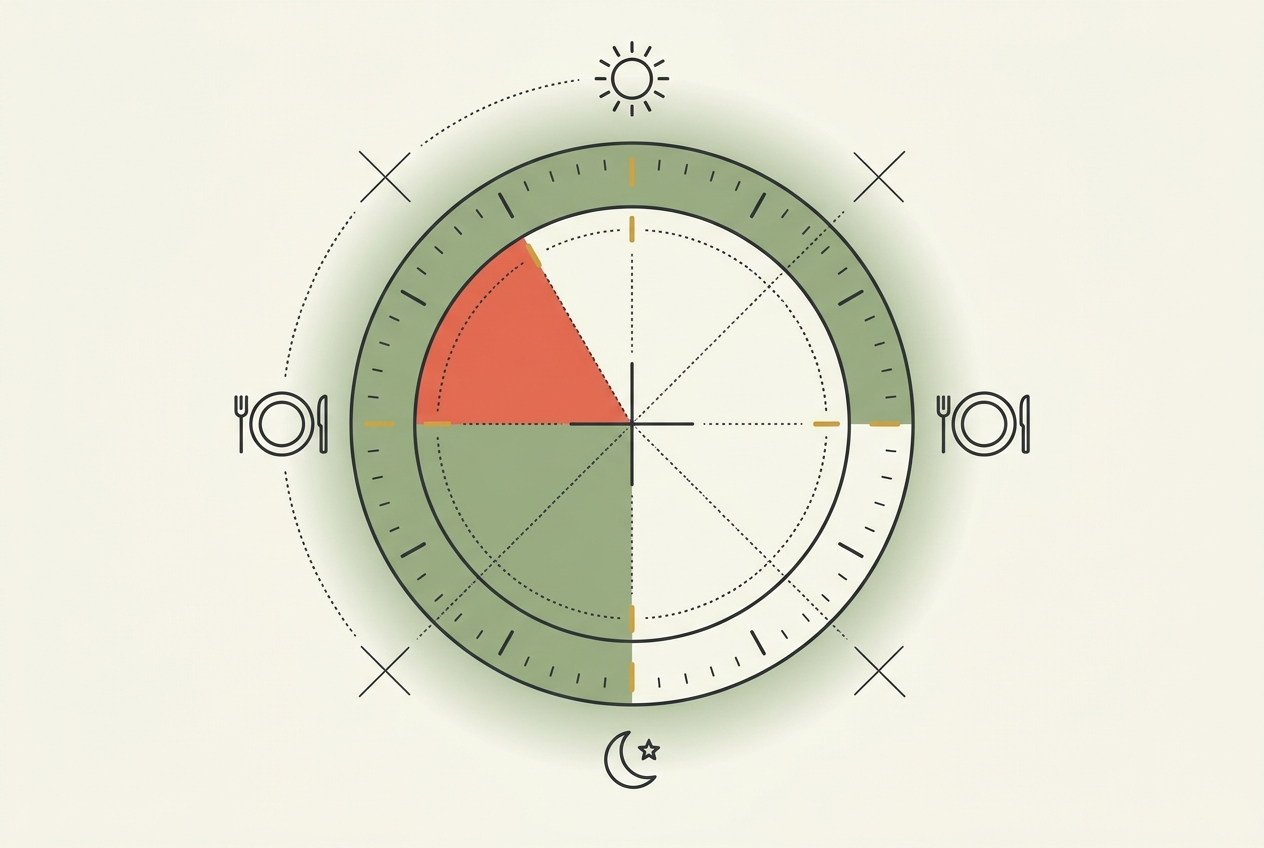
A 10-hour eating window, for example, 8am to 6pm, or 10am to 8pm, is associated with meaningful metabolic benefits in multiple studies while remaining compatible with normal social and family eating patterns. This window provides roughly 14 hours of fasting per day, during which fat oxidation is elevated and the body has extended time in a lower-insulin state.
The 10-hour window is the Forkd default recommendation, it sits in the sweet spot of strong evidence, lifestyle practicality, and a safety profile not flagged in the 2024 AHA data.
8 Hours: Effective but Use With Awareness
An 8-hour window, the popular "16:8" protocol, is well-documented to produce weight loss and metabolic improvements. It is the most studied TRE approach, and its short-term benefits are not in question. The AHA (2024) observational finding raises uncertainty about long-term use specifically for this window length, however.
For people who do well on 16:8 and have no cardiovascular risk factors, continuing with awareness is reasonable. For those with existing heart disease, hypertension, or elevated cardiovascular risk, the 10–12 hour window is a more conservative choice.
Under 8 Hours: Diminishing Returns
Windows shorter than 8 hours, such as a 6-hour window ("18:6") or one meal a day ("OMAD"), significantly compress the opportunity to meet nutritional needs, especially protein, fiber, and micronutrient targets. The cardiovascular concern is amplified in this range, and the ability to consume 20–30g of protein across meals becomes practically difficult when meals are limited to one or two sittings.
How Do You Set Your Daily Eating Window?
The most important rule: your eating window should be consistent day-to-day. Circadian biology responds to regularity, an eating window that shifts widely from day to day (common on weekends) reduces the metabolic signal of TRE even if the average window length is appropriate.
Practical Framework
- Identify your natural last meal time, what time do you typically finish eating in the evening?
- Count back 10–12 hours, that is your suggested start time for eating
- Protect the window at both ends, no calories (including milk in coffee) outside the window; plain water, black coffee, and unsweetened tea are fine
- Anchor to a consistent wake time, morning light exposure and consistent sleep/wake timing reinforce the circadian rhythm that TRE works with
Example Windows
| Window | Start | End | Fasting Hours |
|---|---|---|---|
| 12-hour | 7:00 am | 7:00 pm | 12 |
| 10-hour (recommended) | 8:00 am | 6:00 pm | 14 |
| 10-hour (later) | 10:00 am | 8:00 pm | 14 |
| 8-hour | 12:00 pm | 8:00 pm | 16 |
Morning vs. Evening Alignment
Research suggests that eating windows aligned with the first half of the day (earlier eating) produce stronger metabolic effects than late-day windows, because insulin sensitivity is naturally higher in the morning. However, late-shifted windows (e.g., noon to 8pm) are far more common in practice because they allow skipping breakfast rather than dinner, which is easier to sustain socially.
Both approaches produce meaningful results. If you can manage an earlier window, the metabolic signal may be stronger. If an evening window is more realistic for your lifestyle, it is still effective.
How Does Forkd Calculate Your Fasting Goal?
When you set your eating window in Forkd, the app automatically calculates your daily fasting target as the inverse, a 10-hour eating window gives a 14-hour fasting goal. The fasting timer tracks your progress in real time, and a contextual message at 50% completion, "your body is switching to fat-burning mode", reflects the approximate point at which hepatic glycogen begins to deplete and fat oxidation meaningfully increases.
A safety warning triggers at fasting periods of 17 hours or more, recommending medical supervision before extending further.
Frequently Asked Questions
Can I Drink Coffee or Tea During the Fasting Window?
Black coffee, plain tea, and sparkling water are generally considered acceptable within a fasting protocol. They contain negligible calories and do not meaningfully stimulate insulin. Adding milk, sugar, or cream breaks the fast, these should be reserved for within your eating window.
What If My Eating Window Shifts on Weekends?
Some shift is normal and manageable. The research suggests that keeping variation within 1–2 hours maintains most of the metabolic benefit. Larger shifts, particularly eating 3–4 hours later on weekends, reduce the circadian consistency that amplifies TRE's effects. If social eating makes consistency difficult, a 12-hour window is much easier to maintain flexibly.
Will I Feel Hungry Outside My Eating Window?
Initial hunger during the fasting window is common for the first 1–2 weeks as the body adjusts. Most people find hunger diminishes significantly after this adaptation period. Staying well-hydrated and ensuring adequate protein and fiber within meals reduces the intensity of fasting-window hunger.
Is It Okay to Fast Differently on Training Days?
Some athletes and active individuals adjust their window on training days, particularly around morning training sessions. Eating within 1–2 hours of a significant training session supports recovery. The eating window can be shifted earlier on training days without undermining the overall fasting practice.
Key Takeaways
- Research supports 8–10 hour eating windows for weight loss and metabolic health, with consistent evidence across multiple study types
- A 2024 AHA observational study raised cardiovascular concerns specifically around 8-hour windows, 10–12 hours offers a better safety profile
- 10 hours is the Forkd default recommendation, it delivers meaningful fasting benefit while remaining compatible with normal life
- Consistency matters more than precision, a stable window at 10–12 hours outperforms an irregular 8-hour window
- Earlier eating windows may produce stronger metabolic effects, but later windows work and are more socially practical for most people
References
- Mishra, S., et al. (2023). Time-Restricted Eating and Its Metabolic Benefits. Journal of Clinical Medicine. ncbi.nlm.nih.gov
- Sun, M. L., et al. (2024). Intermittent fasting and health outcomes: an umbrella review of systematic reviews and meta-analyses of randomised controlled trials. eClinicalMedicine (The Lancet). thelancet.com
- American Heart Association. (2024). 8-hour time-restricted eating linked to a 91% higher risk of cardiovascular death. AHA Newsroom. newsroom.heart.org
Written by
Vineet Karhail builds Forkd, the AI-powered calorie and nutrition tracking app, and writes its research-backed guides on calories, macros, and micronutrients.