Does Intermittent Fasting Actually Work? What 100+ Randomised Trials Found
The Short Answer
Yes, intermittent fasting works for weight loss and cardiometabolic health. An umbrella review of systematic reviews covering hundreds of randomised controlled trials found significant benefits for obesity, blood pressure, blood glucose, and cardiovascular markers. However, one large observational study raised concerns about long-term cardiovascular risk with very short eating windows, making how you fast as important as whether you fast.
Disclaimer
This article is for information only and does not replace medical advice. Needs vary with age, sex, and situation (pregnancy, conditions, medication): if in doubt or symptomatic, talk to a health professional.
Why Does Intermittent Fasting Generate So Much Conflicting Evidence?
Few dietary strategies have generated more enthusiasm, or more conflicting headlines, than intermittent fasting. One week it is hailed as a metabolic reset. The next, a new study warns it might harm your heart. What does the full body of evidence actually say?
The answer is more nuanced than either cheerleaders or critics suggest. And the research is now extensive enough to give a clear, balanced answer.
What Is Intermittent Fasting?
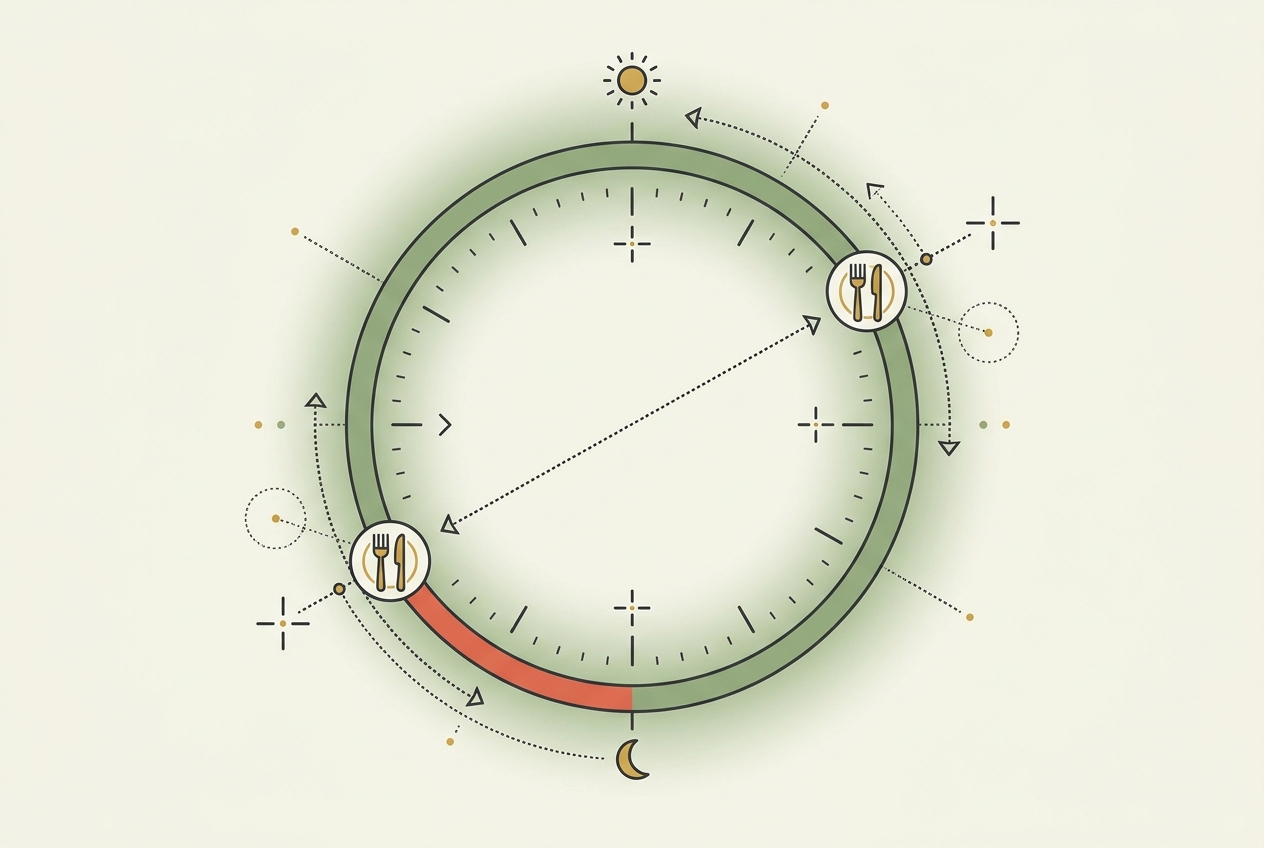
Intermittent fasting (IF) is not a diet in the traditional sense, it does not prescribe what you eat, only when. It describes a range of eating patterns that involve planned periods of fasting, typically 12 hours or longer. The most common approaches include:
- Time-Restricted Eating (TRE): Eating within a defined daily window, commonly 8, 10, or 12 hours, and fasting the rest of the time
- 5:2: Eating normally five days a week and restricting calories severely (typically 500–600 kcal) on two non-consecutive days
- Alternate Day Fasting (ADF): Alternating between regular eating days and fasting or very low-calorie days
- Extended fasting: Periodic fasts of 24–72+ hours, typically practiced weekly or monthly
Forkd's fasting feature is built around time-restricted eating, the most widely researched and most accessible approach for daily practice.
What Did 100+ Randomised Trials Find About Intermittent Fasting?
The Most Comprehensive Evidence to Date
A 2024 umbrella review by Sun et al., published in eClinicalMedicine (The Lancet), synthesised the findings from systematic reviews and meta-analyses of randomised controlled trials on intermittent fasting. This is the highest tier of evidence available, not a single study, but a review of reviews, covering a wide range of IF protocols and health outcomes.
The key findings were striking:
- Intermittent fasting significantly reduced body weight, BMI, and waist circumference compared to non-intervention controls
- Cardiometabolic markers improved, including blood pressure, fasting glucose, insulin, triglycerides, and LDL cholesterol
- Benefits were observed particularly for people with obesity and cardiometabolic conditions
- IF protocols outperformed no-intervention diets on multiple outcomes
This is not a marginal signal. These are consistent effects across multiple study designs, populations, and fasting protocols.
The Metabolic Mechanisms
Mishra et al. (2023) in the Journal of Clinical Medicine reviewed the metabolic effects of time-restricted eating specifically and concluded it is "an effective strategy to reduce overall calorie intake, lose weight, and improve metabolic health and cardiometabolic risk factors."
The mechanism is partly simple: when your eating window shrinks, you tend to consume fewer calories, not necessarily because you are restricting deliberately, but because there are fewer hours in which to eat. Beyond calorie reduction, TRE appears to improve metabolic flexibility, the body's ability to switch between burning glucose and burning fat, by extending the overnight fasting period during which fat oxidation naturally increases.
Why IF May Produce Faster Weight Loss
Research consistently shows that people following intermittent fasting protocols lose weight at a slightly faster rate than those following continuous caloric restriction at the same calorie level. The primary driver appears to be improved adherence, structured eating windows are often easier to maintain than trying to count and limit calories at every meal. The consistency of the fasting period also produces more predictable metabolic outcomes day-to-day.
What Is the Main Risk of Intermittent Fasting?
The Cardiovascular Concern
In 2024, the American Heart Association published findings from a large observational study that attracted significant attention: adults following an 8-hour time-restricted eating window had a 91% higher relative risk of cardiovascular death compared to those eating across 12–16 hours per day.
This finding deserves careful interpretation. It is observational data, it identifies an association, not a confirmed cause-and-effect relationship. People who eat in compressed windows may differ in other health behaviours, underlying conditions, or circumstances that explain some or all of the elevated risk. The researchers themselves cautioned against drawing premature conclusions.
However, the finding is not dismissible either. It is a large dataset, and it serves as a meaningful signal that:
- Very short eating windows (8 hours or less) carry uncertain long-term cardiovascular risk not fully captured in shorter-term RCTs
- The benefits of IF observed in trials (typically 8–52 weeks) may not extend indefinitely without modification
- Window length matters, the dose-response relationship between fasting duration and outcomes is not simply "more fasting = more benefit"
How Should You Read the Intermittent Fasting Evidence?
The tension between the positive RCT evidence (Sun et al., 2024; Mishra et al., 2023) and the observational cardiovascular signal (AHA, 2024) is real, and it is worth sitting with rather than resolving artificially.
The most defensible interpretation is:
- IF, particularly time-restricted eating with a 10–12 hour window, has a strong evidence base for weight loss and metabolic health
- Very aggressive restriction (8 hours or fewer) introduces risks that the shorter-term trial literature may not capture
- Moderate, consistent fasting windows are both effective and likely safer than extreme restriction
This is exactly why Forkd recommends 8–10 hour eating windows as a guideline, and surfaces a specific safety warning for fasting periods exceeding 17 hours.
Who Is Intermittent Fasting Best Suited For?
IF tends to work well for people who:
- Find calorie counting tedious and prefer a simple rule about timing
- Have a natural tendency to skip breakfast without hunger or discomfort
- Eat most of their calories in the evening (a compressed window aligns eating with appetite)
- Want a strategy that reduces late-night eating without explicit restriction
It is less suitable, or requires medical guidance, for:
- People with a history of eating disorders
- Pregnant or breastfeeding women
- People with type 1 diabetes or those on insulin or sulphonylureas (fasting affects glucose management)
- Those with a BMI below 18.5
- Anyone who finds hunger deeply disruptive to concentration or mood
Frequently Asked Questions
Does Intermittent Fasting Work Without Changing What You Eat?
Partially. The weight loss effect of IF is largely mediated through reduced calorie intake, the fasting window naturally limits eating opportunities. Without attention to food quality within the window, results will be smaller. IF works best when paired with nutritious, satiating meals rather than used as a licence to eat freely in a compressed window.
Is Intermittent Fasting the Same as Starving?
No. Starvation is involuntary and sustained; intermittent fasting is voluntary, structured, and time-limited. The metabolic effects also differ, short fasting periods (12–17 hours) trigger fat mobilisation and metabolic improvements that prolonged starvation does not produce and ultimately reverses through muscle catabolism.
Does Intermittent Fasting Preserve Muscle Mass?
This depends on protein intake within the eating window. Research suggests that IF does not inherently cause greater muscle loss than continuous caloric restriction, but adequate protein (1.0–1.2 g/kg/day) distributed across meals within the eating window is essential to preserve lean mass during a fasting-based weight loss approach.
How Quickly Does Intermittent Fasting Produce Results?
Most studies observe meaningful weight loss within 8–12 weeks of consistent IF practice. Metabolic markers (fasting glucose, blood pressure, triglycerides) often improve within 4–8 weeks. As with any dietary approach, consistency over weeks is what drives results, not the first few days.
Key Takeaways
- An umbrella review of 100+ RCTs confirms IF produces significant weight loss and cardiometabolic improvements (Sun et al., 2024)
- Time-restricted eating reduces calorie intake naturally and improves metabolic flexibility
- A large observational study linked 8-hour eating windows to elevated cardiovascular mortality risk, a signal that warrants moderating rather than maximising fasting hours
- 10–12 hour eating windows offer the strongest evidence-to-risk profile for most healthy adults
- IF works best as a framework for reducing calorie intake, not as a substitute for food quality
References
- Sun, M. L., et al. (2024). Intermittent fasting and health outcomes: an umbrella review of systematic reviews and meta-analyses of randomised controlled trials. eClinicalMedicine (The Lancet). thelancet.com
- Mishra, S., et al. (2023). Time-Restricted Eating and Its Metabolic Benefits. Journal of Clinical Medicine. ncbi.nlm.nih.gov
- American Heart Association. (2024). 8-hour time-restricted eating linked to a 91% higher risk of cardiovascular death. AHA Newsroom. newsroom.heart.org
Written by
Vineet Karhail builds Forkd, the AI-powered calorie and nutrition tracking app, and writes its research-backed guides on calories, macros, and micronutrients.