Does AI Food Tracking Actually Work With Your Cuisine? What 50+ Regional Databases Really Mean
The Short Answer
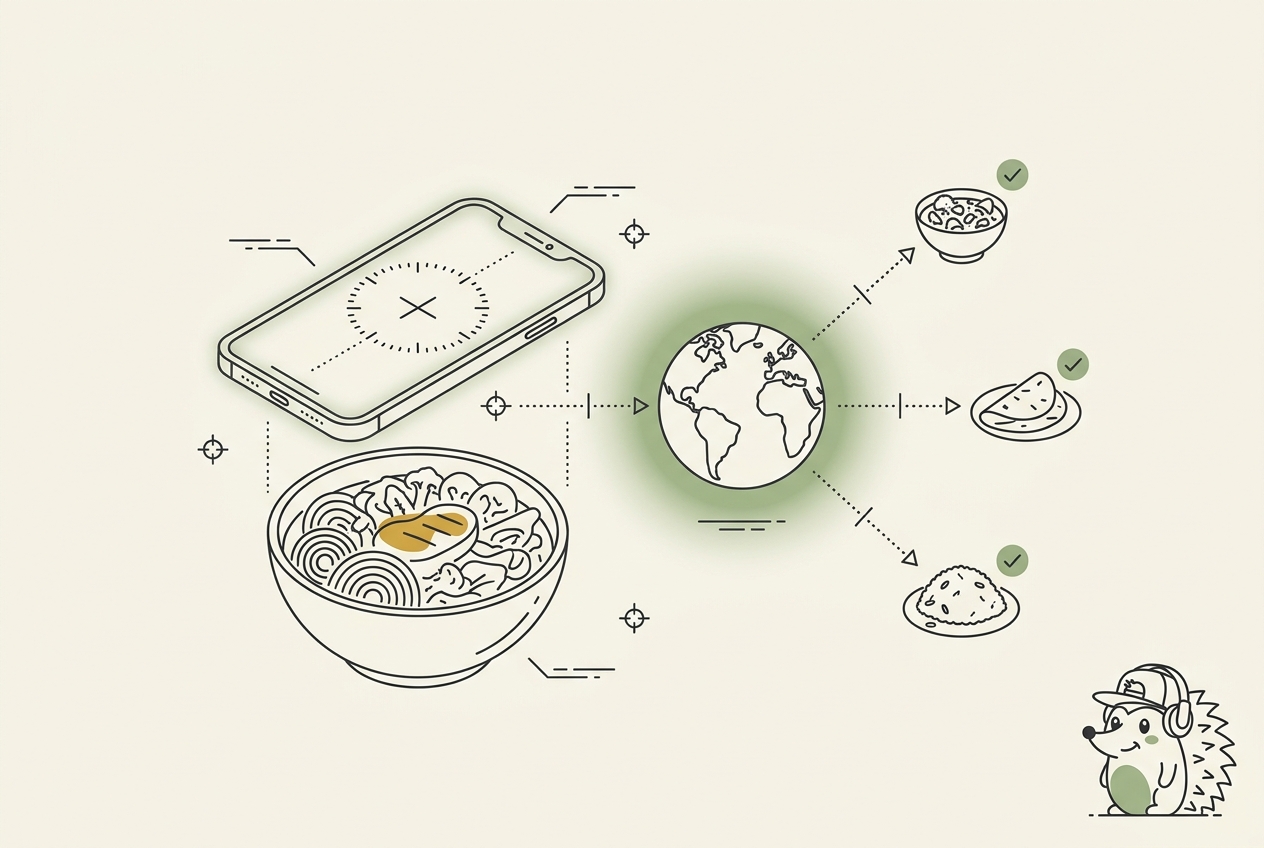
Yes, Forkd recognises food from 50+ countries using cuisine-specific databases rather than generic global averages. Your local dishes, cooking methods, and regional portion sizes are built into the recognition model. If a specific item isn't in the visual database, manual search covers millions of entries from WHO, USDA, and national nutrition registries worldwide.
Disclaimer
This article is for information only and does not replace medical advice. Needs vary with age, sex, and situation (pregnancy, conditions, medication): if in doubt or symptomatic, talk to a health professional.
Why Does Regional Food Recognition Matter?
Most calorie tracking apps were built around Western food databases, primarily US, UK, and Western European foods. When users outside these regions use these apps, they encounter a familiar problem: their everyday foods are missing, misidentified, or have incorrect nutritional values because the app is approximating from the nearest Western equivalent.
This matters nutritionally because regional cuisines differ significantly in their preparation methods, staple ingredients, cooking oils, spice profiles, and typical portion conventions. A West African groundnut stew, an Indian dal, a Japanese teishoku set meal, or a Mexican pozole cannot be accurately described by substituting the nearest Western equivalent. The macronutrient and micronutrient profiles can be meaningfully different.
Passarelli et al. (2024) in The Lancet Global Health, modelling dietary micronutrient inadequacies across 185 countries, found that dietary patterns, and therefore nutritional gaps, vary significantly by region. Understanding nutritional intake across diverse cuisines requires databases that reflect those cuisines accurately, not averaged or approximated data.
What Do Country-Specific Cuisine Databases Actually Include?
Country-specific databases go beyond simply having a food's name in the local language. They include:
Region-specific preparation methods. "Fried rice" means different things in different countries, the oil type, additions, and nutritional profile of Chinese fried rice differ from Nigerian fried rice, Indonesian nasi goreng, and Filipino sinangag. Country-specific databases encode these differences rather than applying a single generic entry.
Local ingredient variants. The nutritional profile of cassava varies by variety and preparation (raw, boiled, fermented, fried). Plantain at different ripeness stages has different macronutrient profiles. Regional varieties of staple grains, legumes, and vegetables may have different protein, fiber, and micronutrient content than the "average" value used in international databases.
Culturally appropriate portion conventions. Portions are not universal. The standard serving size for rice in Japan differs from that in South Asia, which differs again from West Africa. A database that forces all users to estimate against a US-standard portion size creates systematic error for everyone eating in a cultural context where portions are larger or smaller.
Composite dish entries. Regional databases include common local mixed dishes as single entries, dal makhani, jollof rice, beef rendang, birria, pho, with nutritional values derived from local food composition analyses, not reconstructed from component approximations.
Which Regions and Countries Does Forkd's Database Cover?
Forkd's 50+ country databases include coverage across:
- South and Southeast Asia: India, Pakistan, Bangladesh, Sri Lanka, Thailand, Vietnam, Indonesia, Philippines, Malaysia, Singapore
- East Asia: Japan, South Korea, China, Taiwan, Hong Kong
- Middle East and North Africa: Saudi Arabia, UAE, Egypt, Lebanon, Turkey, Iran, Morocco
- Sub-Saharan Africa: Nigeria, Ghana, Kenya, South Africa, Ethiopia, Senegal
- Latin America: Mexico, Brazil, Colombia, Argentina, Peru, Chile
- Europe: UK, France, Germany, Italy, Spain, Poland, Portugal, Greece, Netherlands
- Oceania: Australia, New Zealand
For each covered country, the database draws on national food composition data where available, including country-specific studies referenced in WHO and FAO nutritional databases, regional dietary surveys, and nationally published food composition tables.
What Happens If a Specific Food Is Not in the Database?
Even 50+ country databases cannot include every regional variant, home recipe, or locally named dish. When the AI does not recognise a food or returns a low-confidence estimate, several fallback options improve accuracy:
How Does Manual Search Work for Regional Foods?
Forkd's manual search function covers millions of food entries drawn from international databases including USDA FoodData Central, WHO/FAO regional food composition tables, and partner national databases. This library significantly exceeds the visual recognition database, meaning many foods the AI cannot see can be found through text search.
Searching in the local language returns better results for regional foods than searching in English for many cuisines, the database indexes in multiple languages.
What If You Cannot Find a Dish Anywhere?
For foods genuinely absent from all databases, specific regional home recipes, hyperlocal preparations, or newly created packaged foods, Forkd allows manual entry by ingredient:
- Enter each main ingredient separately with estimated quantities
- The app calculates the combined nutritional profile
- Save as a custom recipe for future use
This approach is used by dietitians for precise nutritional analysis of home cooking and is the most accurate method for dishes with no database entry.
How Does Forkd Handle Mixed-Heritage and Fusion Meals?
Dietary patterns are increasingly global, a household in London might cook Indian one night, Ethiopian the next, and Japanese the next. Forkd's multi-database architecture means the app draws from the appropriate regional database for each meal rather than applying a single cultural lens.
This matters for accurate micronutrient tracking in particular. Different cuisines use different staple vegetables, spices, cooking oils, and preparation methods, all of which contribute meaningfully to the micronutrient profile of a day's eating. A single-database app captures only part of this picture for users eating across multiple traditions.
Why Does Nutritional Database Accuracy Matter for Weight Loss?
For the goal of weight loss, the most important nutritional variable is calorie accuracy, and poorly matched database entries introduce systematic error. If the closest available entry for a dish consistently overestimates calories (as would happen if a lighter regional preparation is matched to a heavier Western analogue), the user's deficit tracking is persistently wrong in the same direction.
Hall (2008) in the International Journal of Obesity established that sustained calorie deficit, calibrated to body weight, is the primary driver of fat loss. Accurate database matching is what makes that calibration real rather than theoretical. An app that consistently mismatches regional foods introduces errors that compound over weeks into significant miscalculation of actual intake.
Frequently Asked Questions
Does Forkd work without an internet connection?
Core food recognition and database lookup require an internet connection to access the cloud-based database. Commonly logged foods are cached locally for offline access. Planning to be offline? Log or save your common meals in advance to ensure they're cached.
What if my region is not in the supported database list?
If your country is not currently covered by a dedicated database, Forkd defaults to the closest available regional database (by cuisine similarity) and flags this in the confidence rating. Manual search across international databases remains available regardless of region. You can also request coverage for specific regions through the app's feedback function, regional database additions are prioritised based on user demand.
Is the nutritional data the same as local food labels?
Nutritional database values represent averages derived from laboratory analysis of food samples. Actual food varies by preparation, variety, and sourcing, the same dish made by different cooks will differ. This variability exists whether you use a local database or a global average. Country-specific databases reduce the error from cultural mismatch; they do not eliminate all variation.
How does the app handle restaurant food from my region?
For regional restaurant food, Forkd's AI identifies the dish type and maps it to the nearest database entry, with confidence reflecting how well the visual match corresponds to the specific restaurant preparation. For chain restaurants that submit nutritional data officially, direct database entries are available. For independent local restaurants, the regional dish entry is the closest approximation.
Key Takeaways
- Forkd uses 50+ country-specific cuisine databases, not Western-approximated averages, local dishes, portion sizes, and preparation methods are captured accurately
- Country-specific databases include region-specific ingredients, preparation methods, and composite dish entries that generic databases miss
- Manual search covers millions of entries from WHO/FAO, USDA, and national databases as a fallback for items not in the visual recognition database
- For dishes absent from all databases, manual ingredient entry and custom recipe saving provides precise nutritional data
- Accurate regional databases matter for weight loss because calorie miscalculation compounds over weeks when food entries are systematically mismatched
References
- Passarelli, S., et al. (2024). Global estimation of dietary micronutrient inadequacies: a modelling analysis. The Lancet Global Health. thelancet.com
- Hall, K. D. (2008). What is the required energy deficit per unit weight loss? International Journal of Obesity. ncbi.nlm.nih.gov
Written by
Vineet Karhail builds Forkd, the AI-powered calorie and nutrition tracking app, and writes its research-backed guides on calories, macros, and micronutrients.