How Much Water Should You Actually Drink? The Formula That Replaces '8 Glasses a Day'
The Short Answer
Your daily water target is approximately 30–38 ml per kilogram of body weight, adjusted for activity level. For a 70 kg moderately active adult, that's roughly 2.1–2.7 litres per day. The widely cited '8 glasses a day' rule has no direct scientific basis and significantly underestimates the needs of larger or more active individuals.
Disclaimer
This article is for information only and does not replace medical advice. Needs vary with age, sex, and situation (pregnancy, conditions, medication): if in doubt or symptomatic, talk to a health professional.
Why Is the "Eight Glasses a Day" Rule Wrong?
The advice to drink eight glasses (about 2 litres) of water per day is one of the most repeated nutrition rules in existence, and one of the least grounded in evidence. The figure does not account for body weight, activity level, climate, or the water content of foods. It is a convenient simplification, not a prescription derived from physiology.
For a 50 kg sedentary woman, 2 litres may be more than needed. For a 100 kg man who exercises daily, it may be a full litre short. The one-size-fits-all approach has led to both over- and under-hydration being ignored because people assume the fixed number covers them. The research-supported approach is personalised.
What Is the Weight-Based Formula for Daily Water Intake?
The Institute of Medicine's Dietary Reference Intakes (2002) established adequate intake levels for water based on observed consumption in healthy populations. Rather than a flat daily figure, adequate hydration scales with body size, metabolic rate, and activity, all of which are predicted by weight.
The practical formula used in clinical and sports nutrition settings is:
Daily water target = Body weight (kg) × 30–38 ml
The multiplier adjusts for activity:
| Activity Level | Multiplier | Example: 70 kg person |
|---|---|---|
| Sedentary (desk job, little movement) | 30 ml/kg | 2.1 litres |
| Lightly active (light exercise, active job) | 33 ml/kg | 2.3 litres |
| Moderately active (regular exercise, 3–5 days/week) | 35 ml/kg | 2.45 litres |
| Very active (daily training, physical work) | 38 ml/kg | 2.65 litres |
Forkd applies this formula with a practical range of 1,500–4,000 ml per day as the absolute bounds, a floor that ensures minimum physiological function and a ceiling above which the risk of overhydration (hyponatraemia, or low blood sodium from excessive water dilution) begins to apply.
Why Does Water Matter Beyond Just "Staying Hydrated"?
Water and Fat Metabolism
Lipolysis, the breakdown of stored fat into free fatty acids, requires water. Fat cannot be mobilised from adipose tissue without adequate hydration. This is not a marginal effect: chronic low-grade dehydration suppresses fat oxidation and reduces the metabolic benefits of both exercise and fasting.
The kidneys require adequate water to efficiently excrete the metabolic byproducts of fat breakdown. When fluid intake is too low, the liver is recruited to assist kidney function, which reduces the liver's capacity to metabolise fat. Maintaining hydration keeps fat metabolism running at full efficiency.
Water and Appetite Regulation
Water occupies stomach volume without contributing calories. Research on preloading, drinking water before meals, has consistently found that it reduces meal calorie intake by 10–15% in adults. The Institute of Medicine (2002) identified water intake as integral to satiety regulation, partly through gastric distension and partly through the effect of hydration on leptin sensitivity (the hormone that signals fullness).
For people managing a calorie deficit, strategic hydration, 400–500 ml before meals, is a low-effort tool for reducing hunger without restriction.
Water and Energy Levels
Even mild dehydration (1–2% of body weight in fluid loss) is associated with reduced cognitive performance, increased perceived effort during exercise, and lower physical endurance. During weight loss, when energy levels are already challenged by a calorie deficit, adequate hydration is an important buffer against the fatigue that can undermine adherence.
Water and Digestion
Dietary fiber, one of the most important components of a healthy diet, requires water to function. Soluble fiber absorbs water to form the viscous gel that slows digestion and moderates blood glucose. Insoluble fiber uses water to add bulk and propel material through the intestine. Low water intake alongside a high-fiber diet can paradoxically worsen constipation and gastrointestinal discomfort. Meeting fiber targets (25–30g/day) and hydration targets together is a package.
Does Food Count Toward Your Water Target?
Yes, significantly. On average, food contributes approximately 20–30% of total daily water intake, depending on diet composition. Fruits and vegetables are particularly water-rich:
| Food | Water Content (%) |
|---|---|
| Cucumber | 97% |
| Lettuce | 96% |
| Celery | 95% |
| Tomatoes | 94% |
| Watermelon | 92% |
| Strawberries | 91% |
| Oranges | 87% |
| Yoghurt | 85% |
| Cooked oats | 84% |
| Cooked rice | 68% |
| Cooked chicken | 65% |
This means people eating large amounts of vegetables and fruit naturally consume significantly more water than their beverage intake alone would suggest, and their fluid needs from drinks are correspondingly lower. Conversely, people eating primarily dry, processed foods need to compensate through higher drink intake. The formula of 30–38 ml/kg represents total fluid from all sources, but beverages (primarily water) should account for the majority.
Do Coffee and Tea Count?
Caffeinated beverages have a mild diuretic effect, they increase urine output modestly, but research has consistently found that the fluid in caffeinated drinks is largely retained, and their net contribution to hydration is positive. The Institute of Medicine (2002) concluded that caffeinated beverages do count toward total fluid intake for the purposes of meeting daily targets.
However, caffeinated drinks are not a substitute for water for people who are exercising heavily or in hot conditions, where fluid losses from sweat significantly exceed what modest caffeine-driven diuresis affects.
Alcohol is dehydrating, it suppresses antidiuretic hormone (ADH), increasing urine output and leading to net fluid loss. Alcoholic drinks do not count toward hydration targets.
What Are the Best Practical Strategies for Hitting Your Daily Water Target?
The biggest barrier to adequate hydration is not access to water, it is forgetting to drink it. A few structural approaches make consistent hydration much easier:
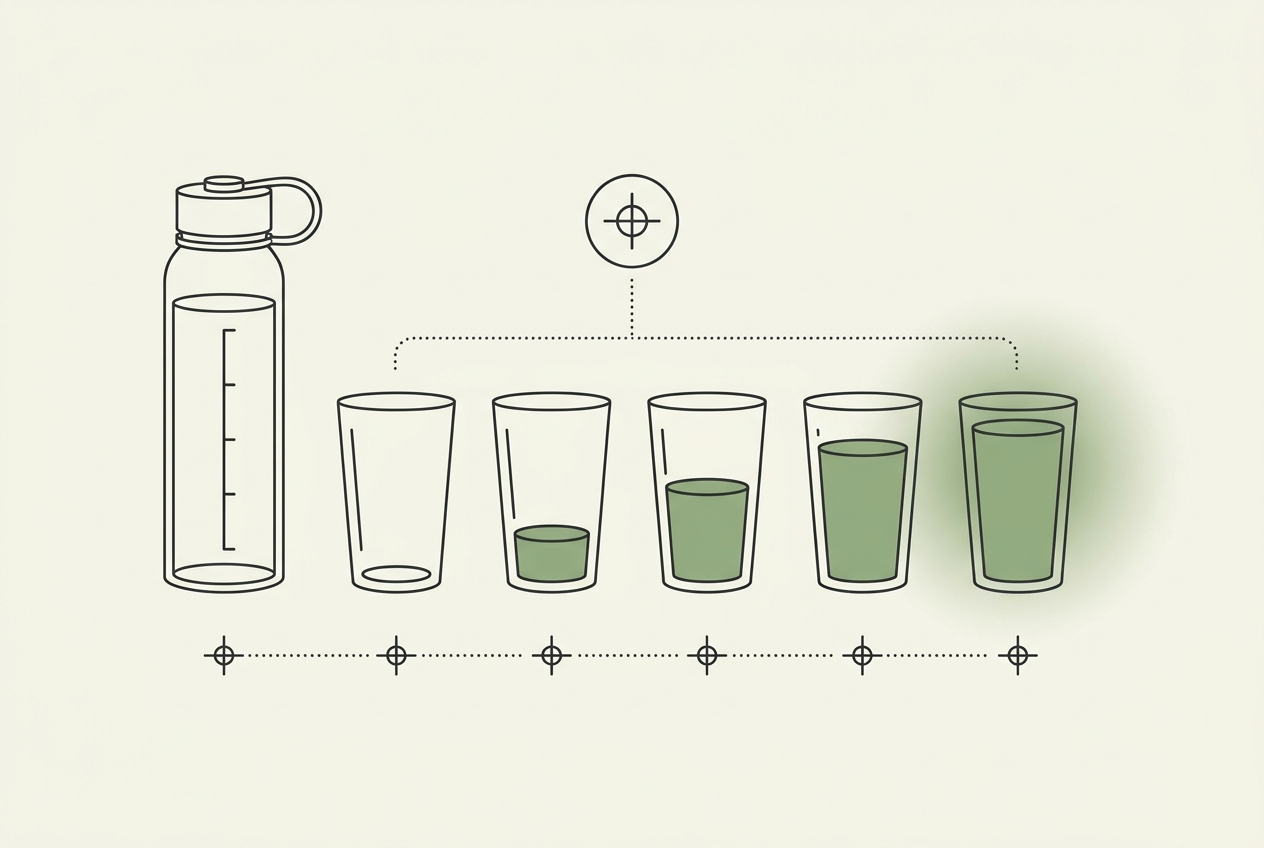
Volume visibility: Fill a 1-litre bottle at the start of the day and track how many times you refill it. Visible progress against a concrete volume is more effective than counting glasses.
Meal anchoring: Drink 400–500 ml before each main meal. Three pre-meal water servings account for 1.2–1.5 litres, a substantial portion of the daily target, and provide the appetite-moderating benefit of gastric preloading.
Time-based reminders: Set three phone reminders at evenly spaced intervals during waking hours (e.g., 9am, 1pm, 5pm). Each reminder serves as a prompt to drink 400–500 ml if you have not been drinking consistently.
Morning hydration: After 7–10 hours of sleep, you are mildly dehydrated. Drinking 500 ml within 30 minutes of waking rehydrates before the day's metabolic demands begin and is associated with improved morning alertness and metabolic function.
Eating window alignment: For people practising time-restricted eating, plain water during the fasting window is not only permitted, it is recommended to maintain hydration while avoiding caloric intake.
What Are the Signs You Are Chronically Under-Hydrated?
Most people are mildly dehydrated relative to optimal function for much of the day. The body does not produce a reliable thirst signal until dehydration is already approximately 1–2% of body weight, by which point cognitive performance and energy are already impaired.
Signs of consistent under-hydration include:
- Urine that is dark yellow or amber (well-hydrated urine is pale straw to clear)
- Persistent fatigue not explained by sleep or caloric intake
- Frequent headaches, particularly in the afternoon
- Constipation or infrequent bowel movements
- Dry skin and lips
- Poor concentration and brain fog mid-morning or mid-afternoon
The simplest daily check: the colour of your urine. Pale yellow is the target. Dark yellow means drink more. Clear means you are drinking more than needed.
Frequently Asked Questions
Should I Drink More Water When Losing Weight?
Yes, for two reasons. First, fat metabolism produces metabolic waste products that the kidneys need adequate water to excrete efficiently. Second, the higher fiber intake associated with healthy weight loss diets requires more water for optimal digestive function. Staying at the higher end of the 30–38 ml/kg range is recommended during active weight loss.
Can I Drink Too Much Water?
Yes, though it is uncommon in everyday conditions. Hyponatraemia (low blood sodium from water dilution) can occur when very large volumes of water are consumed quickly without electrolyte replacement, most commonly seen in endurance athletes over-drinking during events. For most people eating normally, drinking beyond genuine thirst and above approximately 4 litres per day without heavy exercise is unnecessary and potentially counterproductive.
Does Sparkling Water Count the Same as Still Water?
Yes. Carbonated water (without added sodium, sugar, or flavourings) hydrates identically to still water. Some people find it easier to meet their daily target using sparkling water due to its increased palatability. Plain sparkling water is a legitimate hydration tool.
Do I Need Electrolytes as Well as Water?
For most people eating a normal diet, electrolytes (sodium, potassium, magnesium) are adequately supplied through food. Additional electrolytes are most relevant during prolonged exercise (more than 60–90 minutes), in very hot conditions, or during extended fasting. Plain water is sufficient for everyday hydration outside of these conditions.
Key Takeaways
- The "8 glasses a day" rule has no scientific basis, your actual target is 30–38 ml per kilogram of body weight, adjusted for activity
- For a 70 kg moderately active adult, this equals approximately 2.1–2.7 litres per day from all sources
- Water supports fat metabolism, appetite regulation, energy levels, and digestive function, all directly relevant to weight loss
- Urine colour is the most practical daily hydration check, aim for pale yellow
- Structural habits (morning 500 ml, pre-meal 400–500 ml, evenly spaced reminders) reliably outperform willpower-based approaches
References
- Institute of Medicine. (2002). Dietary Reference Intakes for Energy, Carbohydrate, Fiber, Fat, Fatty Acids, Cholesterol, Protein, and Amino Acids. The National Academies Press. nap.nationalacademies.org
- Zhang, W., et al. (2024). Requirements for essential micronutrients during caloric restriction and fasting. Frontiers in Nutrition. frontiersin.org
- Most, J., & Redman, L. M. (2020). Impact of calorie restriction on energy metabolism in humans. Experimental Gerontology. ncbi.nlm.nih.gov
Written by
Vineet Karhail builds Forkd, the AI-powered calorie and nutrition tracking app, and writes its research-backed guides on calories, macros, and micronutrients.