You Know You Should Drink More Water. Here's What Actually Makes You Do It
The Short Answer
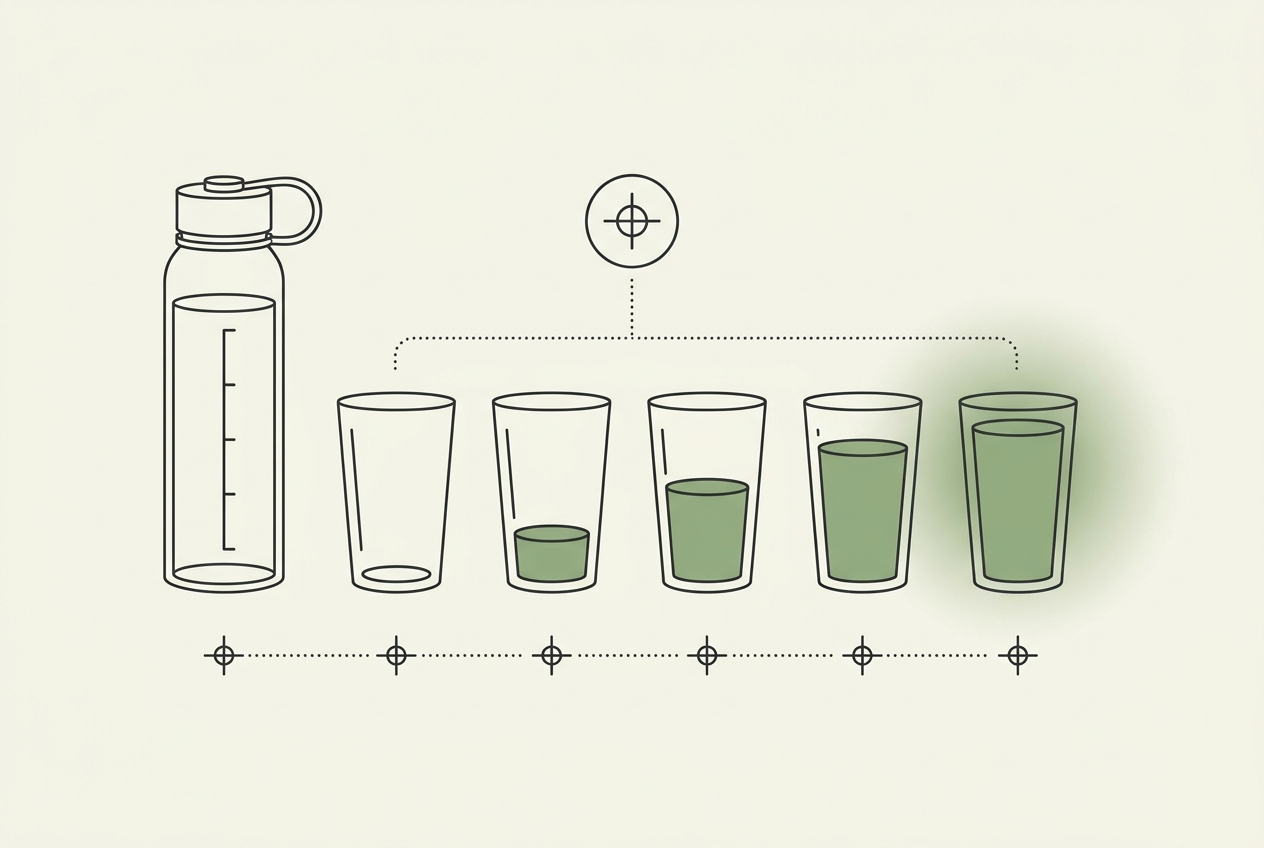
The most effective strategy for consistent hydration is removing the decision from your day: fill a 1-litre bottle each morning and keep it visible, drink 400–500 ml before each main meal, and set three phone reminders spaced through your waking hours. Research on habit formation shows environmental cues and scheduled prompts consistently outperform willpower and good intentions.
Disclaimer
This article is for information only and does not replace medical advice. Needs vary with age, sex, and situation (pregnancy, conditions, medication): if in doubt or symptomatic, talk to a health professional.
Why Good Intentions Are Not Enough to Stay Hydrated
Most people who are chronically under-hydrated are not unaware that they should drink more water. They know. The problem is that drinking water is an action with no natural trigger, unlike eating (hunger) or sleeping (fatigue), there is no reliable biological alarm for mild dehydration that fires before performance is already impaired.
Thirst is a lagging indicator. By the time it registers, you are already 1–2% dehydrated, the level at which cognitive performance, energy, and fat metabolism are measurably impaired. Relying on thirst to prompt drinking means spending most of the day in a mild deficit.
The solution is not motivation. It is structure, making hydration automatic rather than optional.
What Does Research on Habit Formation Actually Show About Hydration?
Behavioural research on habit formation consistently identifies two factors that reliably predict whether a new behaviour becomes automatic: environmental cues and implementation intentions (specific plans of the form "when X, I will do Y").
Vague intentions, "I'll drink more water today", activate goals but not behaviours. Specific implementation intentions, "I will drink a full glass before every meal", tie the behaviour to a reliable, recurring trigger. This distinction is what separates people who successfully change hydration habits from those who don't.
The same principle applies to physical environment. Objects that are visible are used; objects that are stored out of sight are ignored. A water bottle on your desk is a behavioural cue that creates action. The same bottle in a kitchen cupboard is effectively invisible for habit purposes.
The hydration strategies below are not arbitrary tips, they are applications of what habit research tells us about how behaviours become automatic.
What Is the Most Effective Morning Hydration Habit?
Fill a 1-litre bottle and place it on your desk, counter, or wherever you spend most of your morning.
After 7–10 hours of sleep, your body is mildly dehydrated, you've been breathing, perspiring, and metabolising for hours with no fluid intake. Drinking 400–500 ml within 30 minutes of waking rehydrates your cells before the day's cognitive and metabolic demands begin.
The visible bottle serves a dual purpose: it is both the tool for morning hydration and the environmental cue that prompts drinking throughout the morning. Research on the role of the physical environment in health behaviour shows that visibility of health-promoting objects increases use frequency, a factor that matters far more than motivation on any given day.
Finishing one 1-litre bottle before noon, not by strict willpower, but by having it within sight, accounts for approximately 40–50% of most people's daily water target without any further planning.
How Does Drinking Water Before Meals Help Build a Hydration Habit?
Drinking 400–500 ml before each main meal serves two functions simultaneously: it builds a hydration habit anchored to a reliable daily trigger, and it supports appetite regulation during the meal.
Meals are among the most consistent daily events in most people's schedules. Anchoring water drinking to them, as a pre-meal ritual rather than a during-meal habit, creates a reliable implementation intention: "when I sit down to eat, I drink water first."
Three pre-meal water sessions of 400–500 ml account for 1.2–1.5 litres, a substantial portion of the daily hydration target, delivered through a reliable trigger that occurs naturally regardless of willpower.
The appetite benefit is additional: the Institute of Medicine (2002) identified gastric preloading with water as a reliable satiety mechanism. A 400–500 ml volume occupies stomach capacity and extends the satiety signal into the meal, reducing calorie intake without restriction.
Why Do Phone Reminders Work Better Than Trying to Remember to Drink?
Time-based reminders are a form of external implementation intention. They offload the cognitive burden of "remembering" to drink from working memory onto a reliable external system.
Three reminders spaced through the day, for example, at 9am, 1pm, and 5pm, prompt drinking at intervals that prevent the accumulation of large hydration deficits. A single reminder or none at all leaves hours-long gaps in which dehydration quietly compounds.
The key to effective reminders is specificity: "Drink water now" is more actionable than "Drink more water today." Each reminder should be linked to a specific volume goal, 400–500 ml at each prompt, rather than an abstract intention.
Most people who set up this system find that after 2–3 weeks, the phone prompts become less necessary as the behaviour begins to occur automatically before the reminder fires. This is the definition of habit formation: the behaviour moves from deliberate to automatic.
What Does a Well-Structured Hydration Day Look Like?
| Time | Action | Volume |
|---|---|---|
| Within 30 min of waking | Drink from morning bottle | 400–500 ml |
| 9:00 am reminder | Check bottle, drink | 300–400 ml |
| Before lunch (pre-meal) | Drink before eating | 400–500 ml |
| 1:00 pm reminder | Check intake, drink | 300–400 ml |
| Before dinner (pre-meal) | Drink before eating | 400–500 ml |
| 5:00 pm reminder | Evening top-up | 300–400 ml |
This schedule delivers approximately 2.1–2.7 litres from deliberate drinking actions alone, enough to meet the daily target for most people without effort between those anchored moments.
How Does Forkd Integrate Hydration Tracking?
Forkd calculates your personalised daily water target using the weight-based formula (30–38 ml/kg), then lets you log intake in the hydration tracker throughout the day. Progress toward your daily target is visible at a glance, providing the same visual cue as a large water bottle, but in digital form.
Logging intake also creates a mild accountability loop: tracking behaviour tends to increase the frequency of the tracked behaviour, an effect documented in self-monitoring research across dietary, exercise, and hydration contexts.
Frequently Asked Questions
How many glasses of water is 2 litres?
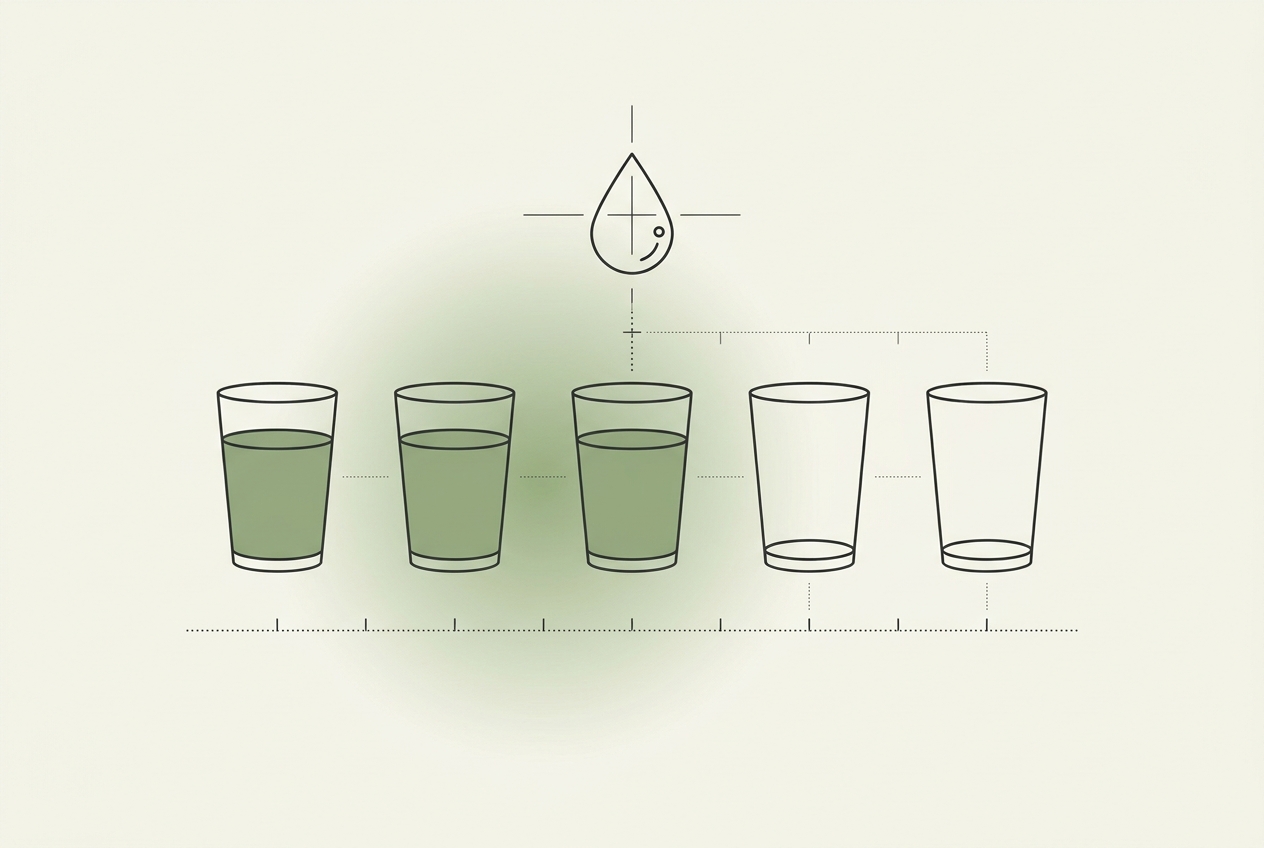
Two litres equals approximately eight 250 ml glasses, or four standard 500 ml glasses. However, tracking by glasses is less reliable than tracking by litres, glass sizes vary enormously. Using a measured bottle (500 ml or 1 litre) with volume markings removes this ambiguity and makes it easier to track progress throughout the day.
Is it better to drink water slowly throughout the day or in larger amounts?
Spreading intake throughout the day is more effective for hydration than drinking large volumes infrequently. The kidneys can absorb water at a rate of approximately 800–1000 ml per hour; drinking more than this rapidly results in a proportion being excreted before it can be absorbed. Regular, moderate intake (300–500 ml per sitting) provides better net hydration than occasional large volumes.
Do I need to drink more water when exercising?
Yes. Exercise increases fluid loss through sweat and respiration. The general guidance is to drink 400–600 ml of water before exercise, 150–250 ml every 15–20 minutes during exercise, and enough post-exercise to replace sweat losses (a practical check: aim to return to pre-exercise body weight). For sessions under 60 minutes at moderate intensity, plain water is adequate; electrolyte replacement becomes relevant for longer or more intense sessions.
Can I drink sparkling water instead of still water?
Yes. Carbonated water (without added sodium, sugar, or flavourings) hydrates identically to still water. Many people find carbonated water easier to drink in larger volumes due to its sensory properties, which can make meeting daily targets more achievable. There is no evidence that carbonation impairs hydration or causes meaningful harm in the quantities used for daily fluid intake.
Should I drink water during a fast?
Yes, and it is recommended. Plain water, black coffee, and unsweetened tea do not break a fast because they contain negligible calories and do not stimulate an insulin response. Staying hydrated during the fasting window prevents the fatigue and headache that many people attribute to fasting but which are often primarily dehydration symptoms. Consistent water intake during the fast also supports the kidney's ability to process the increased metabolic byproducts of fat oxidation.
Key Takeaways
- Thirst is a lagging indicator, by the time you feel it, you are already impaired; build systems before you need them
- A visible 1-litre bottle and three phone reminders are the two highest-leverage habits for consistent hydration
- Pre-meal drinking (400–500 ml) anchors hydration to a reliable daily trigger and reduces calorie intake simultaneously
- After 2–3 weeks, the deliberate system becomes automatic, the goal is to make drinking feel like something you just do
- Forkd tracks your personalised water target and progress throughout the day
References
- Institute of Medicine. (2002). Dietary Reference Intakes for Energy, Carbohydrate, Fiber, Fat, Fatty Acids, Cholesterol, Protein, and Amino Acids. The National Academies Press. nap.nationalacademies.org
- Most, J., & Redman, L. M. (2020). Impact of calorie restriction on energy metabolism in humans. Experimental Gerontology. ncbi.nlm.nih.gov
Written by
Vineet Karhail builds Forkd, the AI-powered calorie and nutrition tracking app, and writes its research-backed guides on calories, macros, and micronutrients.