Net Carbs vs Total Carbs: How to Calculate Net Carbs

The Short Answer
Net carbs are total carbohydrates minus fiber, and minus sugar alcohols on packaged food. The term has no legal definition and the FDA does not regulate it. For whole foods the subtraction is simple: a cup of cooked black beans has 41 g total carbs, 15 g fiber, and 26 g net carbs.
Disclaimer
This article is for information only and does not replace medical advice. Needs vary with age, sex, and situation (pregnancy, conditions, medication): if in doubt or symptomatic, talk to a health professional.
What Are Net Carbs?
Net carbs are the carbohydrates in a food that your body digests and absorbs as glucose. The rest of the carbohydrate on the label, mostly fiber, passes through largely intact, so it contributes little to blood sugar and little usable energy.
The distinction started as a low-carb dieting concept and spread from there. It matters most to people on ketogenic diets, who work with carbohydrate budgets small enough that a few grams either way changes what fits, and to people managing blood glucose, where the goal is predicting the effect of a meal rather than hitting a number.
For everyone else, the concept mainly explains why a cup of beans and a cup of white rice can hold similar carbohydrate on paper and behave nothing alike.
How Do You Calculate Net Carbs?
For whole foods:
Net carbs = total carbohydrate − dietary fiber
For packaged foods with sweeteners:
Net carbs = total carbohydrate − dietary fiber − sugar alcohols
Take a cup of cooked black beans. USDA lists 40.8 g of total carbohydrate and 15.0 g of fiber, so 25.8 g of net carbs. The 15 g you subtract is close to two-thirds of the daily fiber target for many adults, which is a good reminder that fiber grams are not a technicality to be deducted and forgotten.
One warning about labels outside the US. In the EU and UK, the carbohydrate figure on a nutrition panel already excludes fiber, which is declared separately. Subtracting fiber from a European label double-counts it, and the number you get is wrong. American labels list total carbohydrate with fiber included.
Why Doesn't the FDA Recognise Net Carbs?
Because "net carbs" is a marketing term, not a regulated one. The FDA does not define, standardise, or require it. The only carbohydrate information regulated on a US Nutrition Facts panel is total carbohydrate, broken down into dietary fiber and sugars.
Manufacturers calculate net carbs voluntarily, and their methods vary. Two protein bars with identical panels can advertise different net carb counts depending on how each company treats its fibers and sweeteners. When a wrapper claims 2 g net carbs, the useful move is to read the actual panel and do the subtraction yourself.
Which Foods Have the Biggest Gap Between Total and Net Carbs?
The gap is the fiber. All values below come from USDA FoodData Central.
| Food | Portion | Total carbs | Fiber | Net carbs |
|---|---|---|---|---|
| White rice, cooked | 1 cup (158 g) | 41.1 g | 1.4 g | 39.7 g |
| Black beans, boiled | 1 cup (172 g) | 40.8 g | 15.0 g | 25.8 g |
| Lentils, boiled | 1 cup (198 g) | 39.8 g | 15.6 g | 24.2 g |
| Oatmeal, cooked | 1 cup (234 g) | 28.1 g | 4.0 g | 24.1 g |
| Whole wheat bread | 1 slice (32 g) | 13.7 g | 1.9 g | 11.8 g |
| Raspberries | 1 cup (123 g) | 14.6 g | 8.0 g | 6.6 g |
| Cauliflower, raw | 1 cup (107 g) | 5.3 g | 2.1 g | 3.2 g |
| Broccoli, boiled | 1/2 cup (78 g) | 5.6 g | 2.6 g | 3.0 g |
| Almonds | 30 g | 6.0 g | 3.2 g | 2.8 g |
| Avocado, California | 1 fruit (136 g) | 11.8 g | 9.2 g | 2.6 g |
| Chia seeds | 1 oz (28 g) | 11.9 g | 9.8 g | 2.2 g |
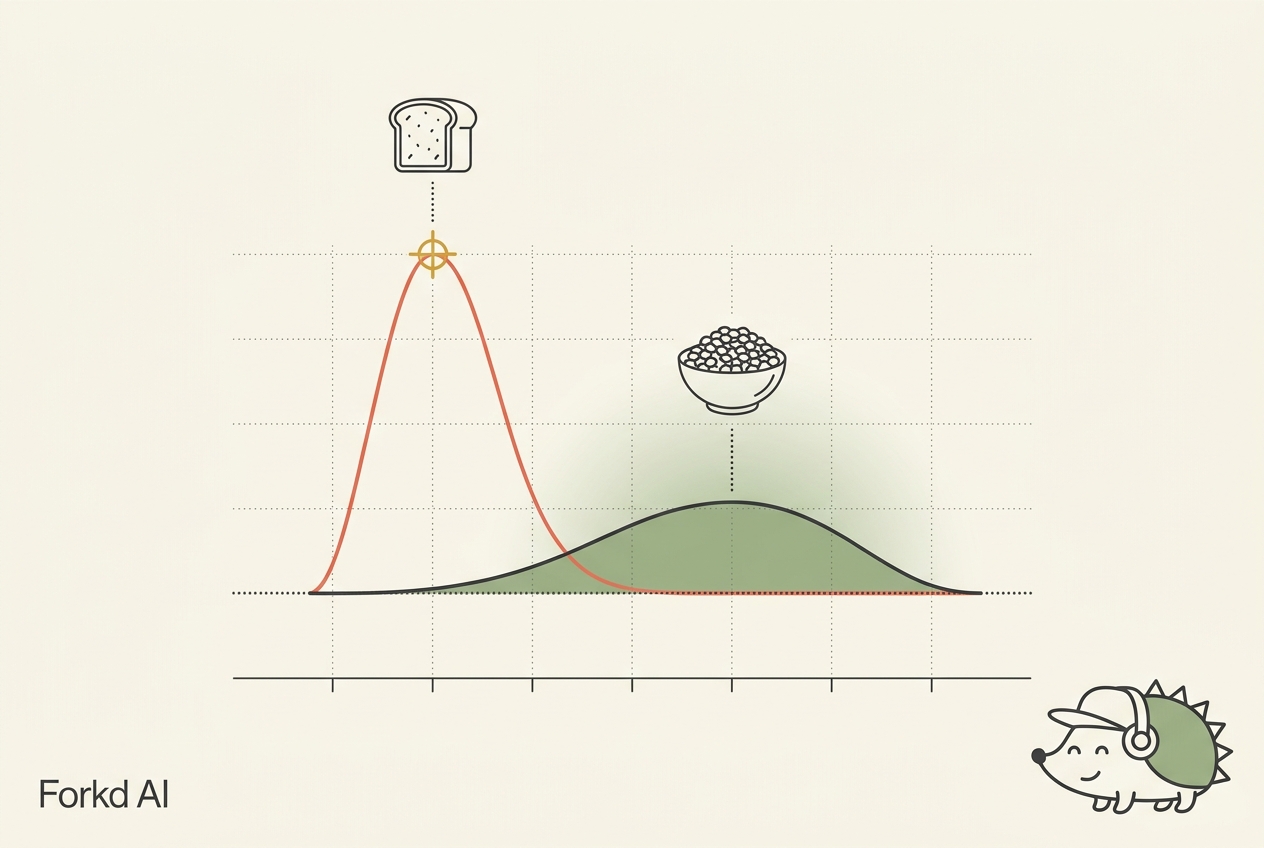
Rice and black beans are the pair worth studying. Their total carbohydrate is nearly identical, and after fiber the beans come in 14 g lower, with the remaining carbohydrate digested more slowly. Chia seeds are the extreme case, where 82 percent of the carbohydrate is fiber.
You can check individual foods against USDA data on our carb content pages, which show total carbs, fiber, and net carbs for each: banana, apple, and sweet potato among them.
Do Sugar Alcohols Really Subtract?
Not evenly, and this is where net carb maths gets unreliable.
Sugar alcohols (erythritol, maltitol, xylitol, sorbitol, isomalt) are incompletely digested, which is the basis for subtracting them. How incompletely varies a lot by type. Erythritol is absorbed in the small intestine and excreted in urine largely unchanged, with essentially no effect on blood glucose or insulin. Maltitol is a different story: it is partially digested and does raise blood glucose, so subtracting all of it overstates the case.
A common convention is to subtract erythritol in full and half of other sugar alcohols. It is a rule of thumb rather than a regulation, and anyone using a glucose monitor will get a more accurate answer from their own readings than from any subtraction rule.
Large amounts of sugar alcohols also cause bloating and digestive discomfort, which is the practical ceiling on sugar-free products long before the carb count becomes a problem. Erythritol's long-term safety has been questioned by observational research linking higher circulating levels to cardiovascular events, so treating "zero net carbs" products as unlimited is not well supported.
Should You Count Net Carbs or Total Carbs?
It depends on why you are counting.
Count net carbs if you are on a ketogenic or strict low-carb diet with a daily budget of 20 to 50 g. At that scale, fiber-heavy vegetables would eat the entire allowance on total carbs, and the diet would push you towards foods with less fiber, which is the opposite of what it should do.
Count total carbs if you are managing type 2 diabetes or on insulin, unless your care team says otherwise. The American Diabetes Association's guidance is to count total carbohydrate and subtract fiber only when a serving provides more than 5 g. Counting total carbs is the more conservative approach when meal-time insulin doses depend on the number.
Ignore both if you are tracking calories for weight loss without a carbohydrate target. Fiber has already been accounted for in the calorie figure, and adding a second carbohydrate calculation gives you nothing to act on. A sensible macro split matters more than which carbohydrate definition you use.
How Do You Track Net Carbs Without Doing the Maths at Every Meal?
Subtracting fiber by hand for eleven ingredients in a stir fry is where most people quietly abandon net carb tracking. The arithmetic is trivial and the friction is not.
Forkd logs a meal from a photo, a voice note, or typed text, then shows total carbs, fiber, and net carbs side by side rather than making you work backwards from a single number. Because fiber is tracked alongside, you can see whether a low net carb day was low because you ate vegetables or low because you ate very little. Those are different days. Search the App Store for "Forkd: Nutrition Intelligence".
If fiber is the part you have been ignoring, how much fiber should I eat daily covers the target and why most people fall short of it.
Frequently Asked Questions
Are net carbs the same as impact carbs?
Yes. "Impact carbs" was the original Atkins-era term for the same idea, that only some carbohydrate has a meaningful impact on blood glucose. Net carbs is the phrasing that stuck. Neither has a regulatory definition.
Do you subtract all fiber, including soluble fiber?
The standard calculation subtracts total dietary fiber, both soluble and insoluble. Soluble fiber is fermented by gut bacteria into short-chain fatty acids, which do supply a small amount of energy, roughly 2 calories per gram against 4 for digestible carbohydrate. The effect is small enough that most systems ignore it, and blood glucose is barely affected either way.
How many net carbs per day for ketosis?
Most ketogenic protocols set 20 to 50 g of net carbs per day, with 20 g being the common starting point for reaching ketosis quickly. Individual tolerance varies with activity level, muscle mass, and how long you have been in ketosis. Blood ketone testing tells you where your own threshold is far better than a generic number does.
Does fiber count towards calories?
Partially. Insoluble fiber passes through undigested and contributes essentially nothing. Soluble fiber gets fermented in the colon and yields around 2 calories per gram. US labels account for this by applying a lower calorie factor to fiber, so the calorie figure on a panel already reflects it and no further adjustment is needed.
Why do European labels show lower carbs than American ones?
Because they are measuring different things. EU and UK labels declare available carbohydrate, with fiber listed separately, so the headline carbohydrate figure is already the net figure. US labels declare total carbohydrate with fiber included. The same food will show a lower carbohydrate number on a European label without anything about the food having changed.
Do net carbs matter for weight loss?
Only indirectly. Weight loss follows a sustained calorie deficit, and carbohydrate accounting does not change that. Where net carbs help is in food choice: high-fiber, low-net-carb foods are more filling per calorie, so they make the deficit easier to hold. The mechanism is satiety rather than anything specific to carbohydrate.
Key Takeaways
- Net carbs = total carbohydrate − fiber, minus sugar alcohols on packaged foods.
- The FDA does not define or regulate net carbs, so package claims are not standardised. Read the panel.
- EU and UK labels already exclude fiber from the carbohydrate figure. Do not subtract twice.
- Sugar alcohols do not all subtract equally. Erythritol has minimal glycemic effect; maltitol does not.
- Count net carbs on a ketogenic diet, count total carbs if you are dosing insulin, and skip the calculation entirely if you are only tracking calories.
References
- US Food and Drug Administration. Nutrition Facts Label: Total Carbohydrate, Dietary Fiber and Sugars. fda.gov
- American Diabetes Association. Get to Know Carbs and carbohydrate counting guidance. diabetes.org
- Regulation (EU) No 1169/2011 on the provision of food information to consumers, Annex I: carbohydrate is defined as available carbohydrate, with fiber declared separately. eur-lex.europa.eu
- Witkowski, M., et al. (2023). The artificial sweetener erythritol and cardiovascular event risk. Nature Medicine, 29, 710-718. nature.com
- USDA FoodData Central. Carbohydrate and fiber values for white rice (169708), black beans (173735), lentils (172421), oats (173905), whole wheat bread (172688), raspberries (167755), cauliflower (169986), broccoli (169967), almonds (2346393), avocado (171706), and chia seeds (170554). fdc.nal.usda.gov
Written by
Vineet Karhail builds Forkd, the AI-powered calorie and nutrition tracking app, and writes its research-backed guides on calories, macros, and micronutrients.