Why Your Food Log Is Lying to You (and How to Fix It)
The Short Answer
The biggest tracking errors are cooking oils, "bites don't count" grazing, weekend amnesia, guessed portions, and calorie-dense sauces. Fixing just the first two typically recovers 200-400 unlogged calories a day.
Disclaimer
This article is for information only and does not replace medical advice. Needs vary with age, sex, and situation (pregnancy, conditions, medication): if in doubt or symptomatic, talk to a health professional.
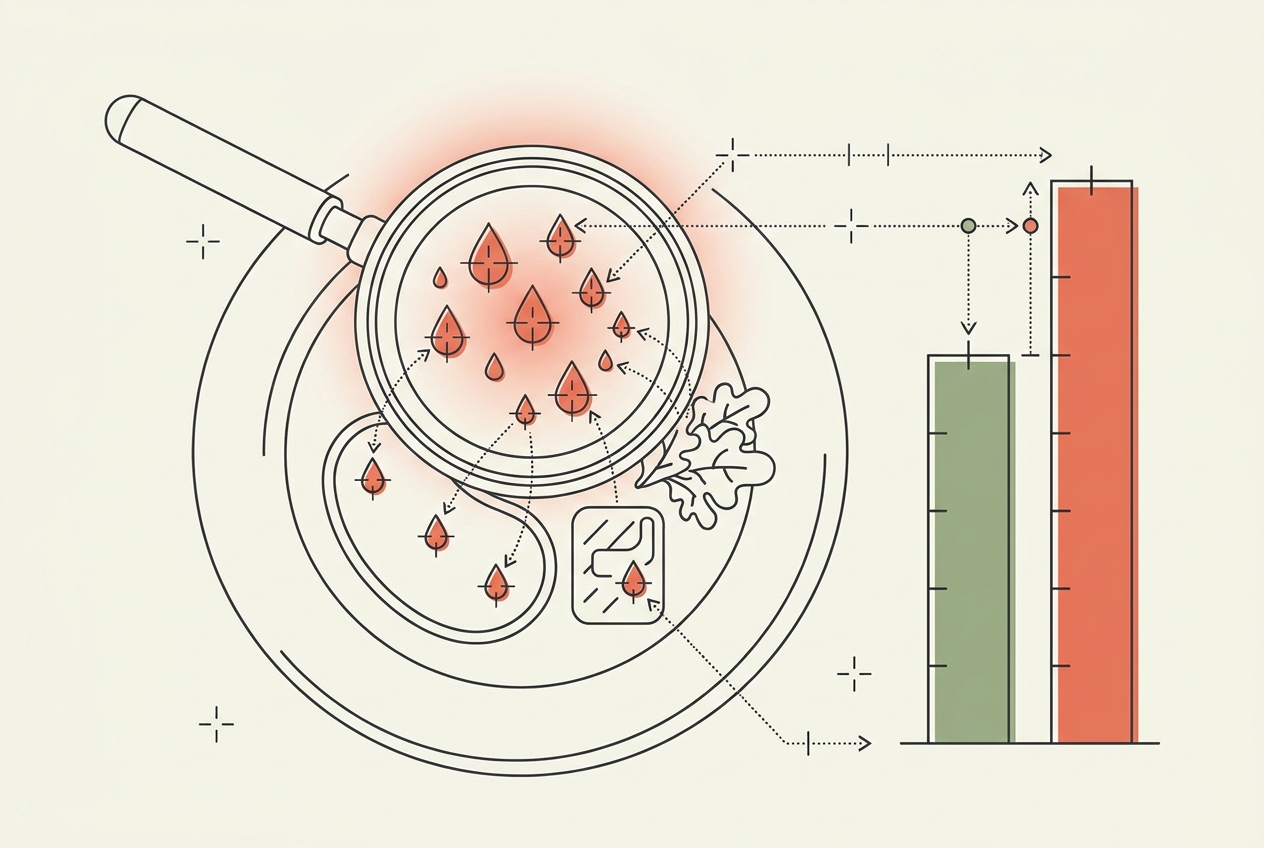
Food logging works, the evidence for that is boringly consistent. But there's a catch buried in the same research: people under-report what they eat by 20–40%, and the more frustrated someone is with their progress, the bigger the gap tends to be. The log says 1,800; the body received 2,400.
This isn't a character flaw. It's a set of predictable blind spots, and they're all fixable.
The big five, ranked by damage
1. Cooking oil
A tablespoon of olive oil is ~120 calories, and nobody who says "a tablespoon" while pouring from the bottle is using a tablespoon. Two generous glugs into a pan can add 300+ calories that never reach the log. Fix: measure oil once with a spoon to calibrate your eye, or log an honest default (like 1.5 tbsp) for every pan-cooked meal.
2. Grazing and "bites don't count"
The handful of your kid's fries, the cheese while cooking, the last third of a croissant a colleague abandoned. Individually trivial, collectively 150–300 calories a day that feel like zero. Fix: a simple rule, if it goes in your mouth, it gets a quick log, even as an estimate. The friction itself reduces the grazing.
3. Weekend amnesia
Many people track Monday–Thursday with monk-like discipline, then log nothing from Friday dinner to Sunday night. If two untracked days run 800 calories over, your true weekly average is ~230/day higher than the log claims, enough to erase a deficit entirely. Fix: log weekends worse rather than not at all. A rough estimate beats a blank.
4. Guessed portions
"A bowl of rice" spans 150 to 500 calories depending on the bowl and the scooper. Fix: you don't need to weigh food forever, weigh your five most common staples (rice, pasta, oats, cereal, nut butter) a few times each. Calibration outlasts the scale.
5. Sauces and drinks
Mayo, peanut sauce, creamy dressings, a splash-heavy latte habit, the second glass of wine. Calorie-dense, easily forgotten, rarely portioned. Fix: attach them to the meal log as a habit, the sandwich isn't logged until its mayo is.
Accuracy beats perfection
The goal isn't a forensic record; it's a log honest enough that adjustments mean something. When your log is 90% honest, a stalled scale tells you to change your plan. When it's 60% honest, a stalled scale just tells you the log is fiction, and you'll "fix" a diet that was never actually being followed.
Forkd's AI logging helps close the gap on the estimation side, snap the meal and get a defensible calorie estimate, sauces and all. But no app can log the untracked weekend for you. The five fixes above are behavioral, and they're worth more than any feature.
Frequently Asked Questions
Do I really have to log every single bite?
You have to account for every bite, which is looser than logging each one. Some people add a flat 100-150 kcal "grazing buffer" to each day instead. That's honest bookkeeping too, the sin isn't imprecision, it's pretending the calories don't exist.
Is weighing food obsessive?
Used forever, it can be. Used for two weeks to calibrate your eyes on staple foods, it's the single highest-leverage accuracy tool available, after which estimates get remarkably good.
My log says I'm in a deficit but I'm not losing weight. Which is wrong?
Over any 3-4 week stretch, the body is the more reliable instrument. If weight is flat, you're at maintenance regardless of what the log claims, audit the five blind spots above before cutting your target further.
Are restaurant calorie counts trustworthy?
Treat them as minimums. Independent checks regularly find real dishes exceeding menu calories, sometimes substantially, because kitchens don't portion like labs. Logging a restaurant meal at 1.2x the menu number is a reasonable hedge.
Written by
The Forkd Team writes practical, evidence-aware guides on calories, macros, and everyday nutrition tracking.